
The Unclosed Door · RFK series
Truth and Justice – The Institutional War Against Reinvestigation and the Collapse of Democratic Legitimacy
Part XVIII of The Unclosed Door
1. Introduction: The Case That Cannot Be Reopened
The death of Robert F. Kennedy should not be a cold case.
It was committed in a public space.
The shooter was captured.
Dozens of witnesses were present.
The forensic trail—if followed honestly—leads to profound contradictions and alternative suspects.
And yet, for over 50 years, every effort to reopen the case has been blocked, mocked, or erased.
This is not the behavior of a democracy at ease with itself.
It is the behavior of an empire preserving its own mythology.
In a state that cannot tolerate self-inquiry, truth becomes a security threat—and justice becomes a mirage.
2. The Legal System: Refusal by Design
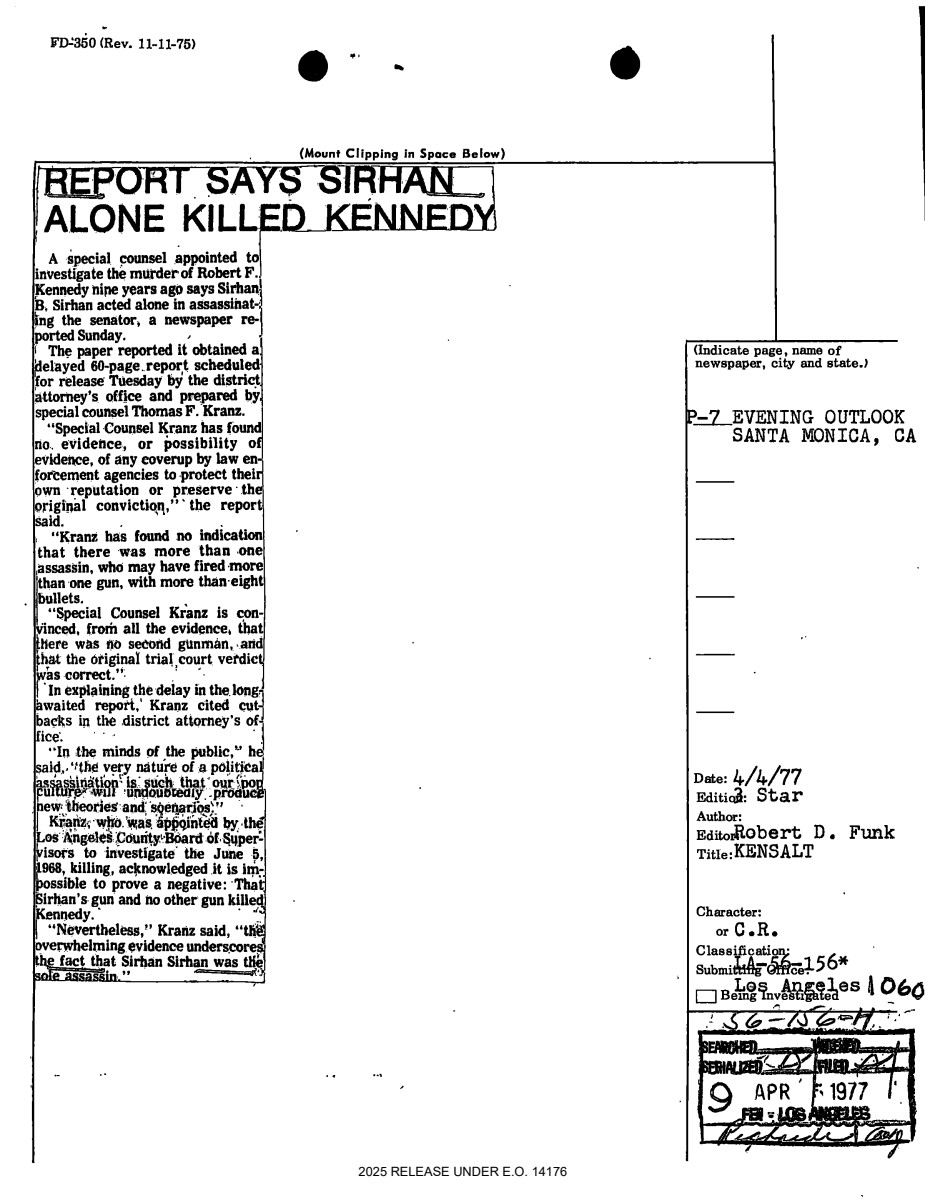
Sirhan Sirhan has petitioned for retrial or parole over a dozen times.
Each attempt has encountered the same pattern:
- Dismissal of new evidence.
- Refusal to examine contradictory forensic findings.
- Reliance on procedural finality (“the matter has been settled”).
- Assertion that Sirhan shows “no remorse,” despite his lifelong amnesia.
The judiciary’s position is clear:
- It is less dangerous to let an innocent man rot in prison than to admit a miscarriage of justice in a high-profile political assassination.
Sirhan’s appeals have presented:
- Acoustic evidence of more bullets than his weapon could fire.
- Ballistic reports suppressed or altered by LAPD.
- Eyewitnesses who contradict the lone gunman theory.
- Testimonies from surviving victims (like Paul Schrade) supporting his innocence.
And still the courts say: “Closed.”
This is not legal reasoning.
It is doctrinal refusal—a bureaucratic firewall built to insulate the architecture of official memory.
3. The Media: Gatekeeping the Impossible
Mainstream journalism in the United States no longer investigates the RFK assassination.
It curates it.
Coverage of reinvestigation attempts follows a familiar structure:
1. Frame alternative theories as “conspiracy.”
2. Highlight the emotion of the moment to drown out forensic details.
3. Interview establishment “experts” to reaffirm closure.
4. Ignore or marginalize whistleblowers and survivors.
When Robert F. Kennedy Jr. publicly stated in 2018 that he believes Sirhan did not kill his father, The Washington Post ran a brief, dismissive piece.
When Paul Schrade testified at Sirhan’s parole hearing and said, “You did not kill Bobby,” The New York Times buried the story.
This is not journalism.
It is narrative policing.
The media no longer functions as the Fourth Estate, but as the final courtroom—where cases are tried in absentia and buried without verdict.
4. Political Cowardice and Institutional Lockstep
No member of Congress—Democrat or Republican—has called for an official reinvestigation of the RFK assassination in decades.
Why?
Because to do so is to:
- Challenge the legitimacy of the justice system.
- Implicate the intelligence community.
- Alienate powerful lobbies (notably pro-Israel groups wary of the Sirhan-Palestine link).
- Risk media exile and donor withdrawal.
Even among the Kennedy family, only a few have spoken out:
- RFK Jr., who has visited Sirhan in prison and publicly questioned the case.
- Douglas Kennedy, who has called for a fair parole hearing.
The rest remain silent.
This is not personal betrayal.
It is ideological conditioning.
The state has trained its elites to understand that the boundary of acceptable memory is patrolled—not by law, but by threatened status.
To cross it is to disappear politically.
5. Forensic Integrity Destroyed: The “Lost” Evidence
Perhaps the most damning indictment of institutional illegitimacy is the physical destruction of evidence:
- The ceiling tiles from the Ambassador Hotel pantry, which showed extra bullet holes, were destroyed by LAPD.
- Doorframes with bullet indentations were patched or discarded.
- The Pruszynski audio tape—recording the shooting—was hidden for decades, then downplayed despite proving at least 13 shots.
- Ballistics were never conclusively matched to Sirhan’s gun.
- Chain of custody on bullets was broken.
This is not negligence.
It is forensic sabotage.
The deliberate destruction of evidence is an admission of institutional guilt—not of individuals, but of a system protecting its own continuity at all costs.
6. The Legal Doctrine of Finality: Justice Replaced by Closure
Modern American jurisprudence emphasizes finality over accuracy.
Once a verdict is rendered—especially in high-profile cases—courts resist reopening them, even in the face of new exculpatory evidence.
Why?
Because to admit an error in the RFK case would:
- Invite challenges to thousands of other politically influenced prosecutions.
- Destabilize public confidence in the integrity of trials.
- Expose systemic corruption that spans generations.
So finality becomes a sacred principle, defended not for justice, but for institutional stability.
RFK’s case is the apotheosis of this doctrine:
- A verdict that cannot be questioned.
- A conviction that cannot be disturbed.
- A silence that must be preserved, even as the corpse of democracy lies cold beneath it.
7. Psychological Operations and the War on Memory
The refusal to reinvestigate RFK’s death is not only bureaucratic—it is psychological.
The goal is to:
- Exhaust those who question.
- Break the will of the curious.
- Make truth-seeking a form of self-destruction.
Witnesses like Paul Schrade, researchers like Lisa Pease, and attorneys like Laurie Dusek have all faced:
- Institutional obstruction.
- Social marginalization.
- Media ridicule.
Their suffering is not collateral.
It is instrumental—a warning to others.
This is the psychology of mass compliance:
- Normalize the irrational.
- Pathologize dissent.
- Replace truth with consensus.
And so RFK’s assassination becomes a ritualized event, fixed in memory not as it was, but as the state needs it to be.
8. Fanon and the Settler State’s Fear of Self-Disclosure
Frantz Fanon taught that colonial powers fear not the uprising of the colonized, but the revelation of their own crimes.
The settler state survives by maintaining the illusion of moral superiority.
To reopen the RFK case is not merely to revisit a murder.
It is to:
- Question the CIA’s role in domestic politics.
- Acknowledge the use of mind control and psychological warfare.
- Admit that American democracy was subverted by intelligence-led assassination.
This is ontological heresy.
It is not that the system doesn’t know RFK’s murder was a coup.
It’s that to admit it would require deconstructing the entire legitimacy of post-1968 governance.
And so silence becomes a mode of being.
9. Dramatic Rendering: The Courtroom of Refusal
Set: A courtroom with no judge, only a red phone. Every time someone speaks, the phone rings and silences them.
Characters:
- A survivor (Schrade) reads his statement. He is ignored.
- A lawyer (Dusek) presents evidence. It is shredded before the audience.
- A journalist (Klaber) asks a question. The phone rings. He vanishes.
Climax:
A young woman rises from the crowd and asks:
“If truth is treason, what is justice?”
A pause.
The red phone rings one final time.
A hand reaches from above and turns off the lights.
10. Conclusion: The Collapse of Democratic Legitimacy
The refusal to reinvestigate the RFK assassination is not a failure of evidence.
It is a defense of structural corruption.
When courts deny hearings despite new proof…
When media refuses to cover surviving witnesses…
When politicians pretend not to know what they surely do…
…democracy becomes ritual, not reality.
Justice is no longer a goal.
It is a performance of silence.
And in that silence, the state reveals itself—not as a servant of the people, but as the guardian of a lie so vast that to expose it would require rebirthing the Republic itself.
And so we arrive at the crossroads:
Truth or preservation.
Justice or consensus.
Memory or oblivion.
The question is not whether we can reopen the case.
It is whether we are still a people capable of doing so.
Source anchor appendix (Part XVIII): reinvestigation efforts and their institutional burial → {TA-AFT-¶009} · {TA-C18-¶040} · {TA-C09-2} · {LB-S18} · {LB-S23}; RFK Jr. → {TA-AFT-¶009} · {LB-ACK-¶011}
More from the Chomsky Analytical Desk
- The Unclosed Door — Visual Index 23 November 2026
- The World RFK Inherited 22 November 2026
- Robert Kennedy’s Political Awakening 22 November 2026
- 1962 – RFK, AIPAC, and the Foreign Agent That Never Was 22 November 2026