
The Unclosed Door · RFK series
The Last Best Hope – RFK’s Unfinished Vision and the World That Might Have Been
Part XIX of The Unclosed Door
1. Introduction: History’s Second Heartbeat
When a visionary is assassinated, what dies is not just a man.
What dies is a possible future—a path untaken, a door welded shut, a generation denied the chance to imagine itself differently.
Robert F. Kennedy’s death was not just a tragedy. It was a strategic excision of a transformational rupture.
His campaign was not merely electoral.
It was existential.
RFK was assembling a coalition unprecedented in American history: poor whites and Black radicals, students and working-class unionists, disillusioned liberals and antiwar veterans. The very constituency that, had it fully realized itself, would have not only ended the Vietnam War, but reconstituted the moral center of the nation.
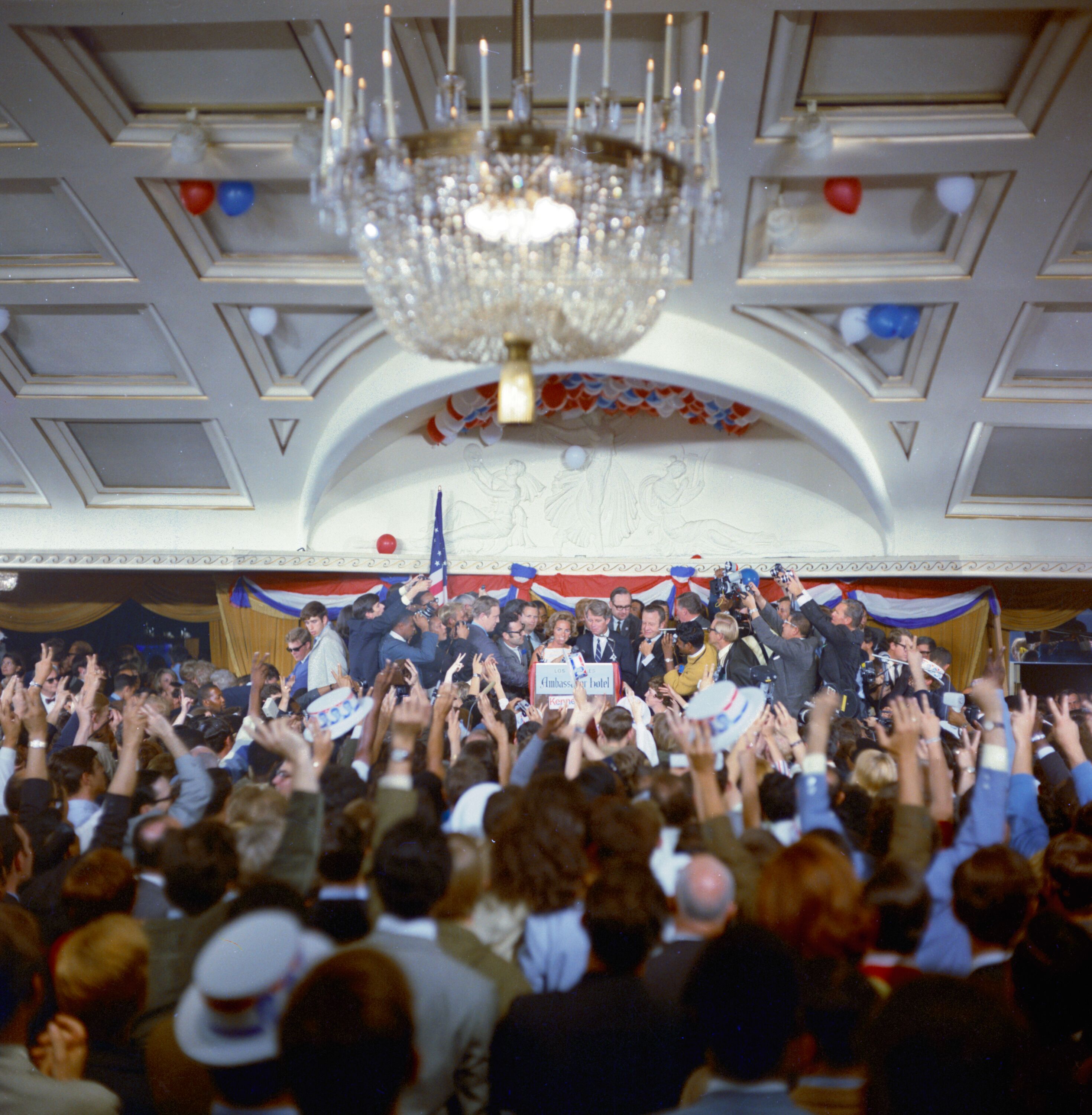
This is not a romantic dream. This is what the system feared most—and why he had to be eliminated.
Let us now resurrect the world that might have been.
2. A Coalition of the Wretched and the Redeemed
RFK’s 1968 campaign was forging a class- and race-transcending alliance.
Consider the facts:
- He drew massive support from Black voters while also winning poor white communities in Indiana and Nebraska.
- He was endorsed by Cesar Chavez and also gained traction in conservative Catholic communities.
- He campaigned in the Mississippi Delta, Harlem, and rural Appalachia—not to exploit pain, but to connect it.
He spoke not in policy abstractions, but in moral clarity:
“We tolerate poverty in the richest country on earth. We send young men to die in a war few believe in. We watch our cities burn and call it progress. We must change.”
This coalition was dangerous because it bypassed the establishment’s racial wedge strategy—which had kept poor people divided since the founding.
Had RFK been elected, he would have presided over:
- A multiracial labor resurgence.
- A new civil rights era, grounded in economic justice.
- A redefinition of American identity rooted not in empire, but in shared dignity.
This coalition has not returned since.
Its last breath died with him in the pantry.
3. The End of Empire: Vietnam, CIA, and a New Foreign Policy
RFK had promised a complete withdrawal from Vietnam.
Unlike LBJ and Nixon, who escalated to protect U.S. hegemony, RFK saw the war as:
- A moral disaster.
- A neocolonial occupation.
- A betrayal of both American soldiers and Vietnamese civilians.
Had he taken office in 1969:
- Over 25,000 American lives would have been spared.
- Hundreds of thousands of Vietnamese deaths would have been averted.
- The Cambodian and Laotian expansions would not have occurred.
- The credibility of anti-imperialist diplomacy would have been restored.
But RFK’s vision extended beyond Vietnam.
He sought to:
- Rein in CIA covert operations.
- Rebuild diplomacy grounded in justice, not manipulation.
- Reestablish executive control over intelligence agencies.
JFK tried and was killed.
RFK tried again—and was stopped before he could begin.
Had he succeeded, the national security state would have been clipped, and perhaps dismantled over time.
Instead, it metastasized.
4. Israel, Palestine, and the Road Not Taken
Robert F. Kennedy was, publicly, a supporter of Israel.
But he also:
- Remembered the 1962 DOJ case against the American Zionist Council.
- Resisted absolute alignment with any foreign lobby.
- Believed in the possibility of justice for the Palestinians.
His campaign never pandered to AIPAC.
He spoke in terms of balance, international law, and restraint.
Had RFK been elected:
- U.S. policy might have avoided the unconditional support model that has defined every administration since.
- Israeli militarism, especially post-1967, would have faced real checks.
- Palestinian self-determination would have entered the American lexicon as a legitimate moral issue, not a security threat.
This pivot was crushed.
With RFK’s death, the Zionization of U.S. foreign policy accelerated—a fact no politician today dares even mention.
5. Economic Populism: Breaking the Corporate State
RFK was no socialist, but he was no neoliberal either.
He criticized:
- Tax shelters for the rich.
- Military-industrial profiteering.
- The disconnect between Wall Street and working families.
He believed:
- Wealth must serve human dignity.
- The state had a role in correcting market violence.
- Corporations should be accountable to democracy, not the other way around.
Had he won:
- Reaganomics would likely have been stillborn.
- The Powell Memo corporate revolution might have been disrupted.
- Labor power might have resurged, not collapsed.
In short, the neoliberal turn might have been arrested before it began.
Instead, RFK’s assassination cleared the runway.
What followed was:
- Deregulation.
- Union-busting.
- Financialization.
- The gutting of the middle class.
The future we now call “inevitable” was, in 1968, a contested choice.
RFK’s election would have taken us another way.
6. Policing and Incarceration: A Human Rights Model Instead of Carceral Capitalism
RFK, as former Attorney General, understood law enforcement intimately.
But unlike his successors, he rejected “law and order” as a substitute for justice.
He visited prisoners. He spoke with gang members. He condemned brutality.
He was evolving—from a former prosecutor into a human rights leader.
Had he taken office:
- The War on Drugs would have been reevaluated, not militarized.
- Policing would have followed a public health model, not a counterinsurgency logic.
- Mass incarceration might never have become the dominant social control structure of the late 20th century.
This was not inevitable.
It was a choice.
And the man who might have made the right one was silenced.
7. Environmentalism, Indigenous Sovereignty, and Anti-Colonial Solidarity
RFK was an early environmental thinker:
- He spoke of preserving rivers, forests, and air not as luxury—but as birthright.
- He saw Indigenous struggles not as “special interests,” but as reminders of America’s original sins.
In speeches, he linked the destruction of nature to the destruction of moral order.
Had he won:
- Earth Day might have become policy, not just symbol.
- Treaties with Native nations might have been honored.
- International anti-colonial movements might have found an ally in Washington, not an enemy.
The postcolonial world was watching in 1968.
They saw what we did.
And they understood the message:
Even your allies will be shot if they get too close to power.
8. Education, Youth, and the Culture of Service
RFK believed in young people.
He didn’t patronize them.
He saw their unrest as wisdom, not threat.
His administration would likely have:
- Expanded the Peace Corps.
- Created new programs of national service.
- Resisted the rise of student debt as a disciplinary apparatus.
He might have ushered in a generation of engaged citizens, not disillusioned workers.
He saw education not as workforce training—but as spiritual preparation for democracy.
That idea has died.
In its place is debt, debt, and more debt.
RFK wanted to liberate minds.
The system chose to monetize them instead.
9. Dramatic Rendering: The Cabinet Room That Never Was
Set: The Oval Office, 1969. RFK sits at the desk.
Around him are imagined figures:
- Dr. King, alive, now Secretary of Urban Affairs.
- Cesar Chavez, Secretary of Labor.
- Paul Schrade, Advisor on Worker Safety.
- Rachel Carson (survived cancer), Advisor on Environment.
A map of Vietnam: U.S. troops in full withdrawal.
A budget: $150 billion redirected from war to housing, schools, medicine.
A phone call: Israel requests more weapons.
RFK hesitates.
He says:
“We support your existence. But not your impunity.”
The room falls silent.
The world turns.
10. Conclusion: The Last Best Hope and the Death of the Possible
RFK’s assassination was not only the elimination of a man.
It was the prevention of the future.
Had he lived and won, we might now inhabit:
- A nation at peace.
- A labor force with power.
- A planet less poisoned.
- A democracy with memory.
Instead, we live in the aftermath of a coup dressed in patriotism, sanitized by media, and buried in consensus.
But the shadow of what might have been has not disappeared.
It follows us.
In every injustice.
In every war.
In every unspoken question.
And so the work of recovery is not only forensic.
It is ontological.
We do not mourn Robert Kennedy merely.
We mourn the America that died with him.
But to mourn is also to remember.
And to remember is the first act of resistance.
Source anchor appendix (Part XIX): counterfactual/synthesis — framing. Legacy voices (RFK Jr., Schrade) → {TA-AFT-¶009} · {TA-C18-¶040} · {LB-ACK-¶011}; the missing finale was written 2026-11-21 as Part XX, “The Unclosed Door”.
More from the Chomsky Analytical Desk
- The Unclosed Door — Visual Index 23 November 2026
- The World RFK Inherited 22 November 2026
- Robert Kennedy’s Political Awakening 22 November 2026
- 1962 – RFK, AIPAC, and the Foreign Agent That Never Was 22 November 2026