
The Unclosed Door · RFK series
The Media as Ministry of Truth – Containment of Narrative Post-Assassination
Part VIII of The Unclosed Door
1. Introduction: Assassination as Communication
In the age of mass media, a political assassination is not merely an act of violence. It is an act of semiotics. The killing itself is only half the operation. The second half—equally important—is its interpretation: who did it, why it happened, and what it meant.
If the first bullet ends a life, the second—symbolic bullet—ends the possibility of dissent.
In the case of Robert F. Kennedy, that second bullet was fired by the American media.
2. The Narrative Emerges: Sirhan, the Lone Gunman
Within 24 hours of RFK’s assassination, major U.S. media outlets—CBS, NBC, The New York Times, Time, Newsweek—had established the storyline:
- Sirhan Sirhan, a Palestinian radical, murdered Kennedy in anger over his support for Israel.
- Sirhan acted alone.
- RFK’s death, though tragic, was the work of a fanatic—random, senseless, apolitical.
This narrative solidified not through investigation, but through repetition.
There was no mention of:
- Ballistic inconsistencies.
- Autopsy contradictions.
- The “girl in the polka-dot dress.”
- CIA or FBI surveillance of RFK.
- RFK’s 1962 attempt to register the American Zionist Council as a foreign agent.
These omissions were not accidental.
They were structural.
3. The Manufacturing of Consent: A System, Not a Conspiracy
Edward Herman and Noam Chomsky’s Manufacturing Consent outlines five filters that shape media output in the service of elite power:
1. Ownership by corporate conglomerates.
2. Advertising as the primary revenue source.
3. Reliance on government and corporate sources.
4. Flak as a disciplinary mechanism.
5. Anti-communism (now anti-dissent) as ideological control.
In the RFK case, all five were active.
- CBS and NBC, owned by military-contracting corporations (GE, Westinghouse), had vested interests in suppressing anti-war narratives.
- Newspapers relied on official LAPD and FBI reports without independent verification.
- Journalists who challenged the narrative—Ted Charach, William Klaber—faced professional exile.
- The “conspiracy theorist” label became the modern version of heretic: discredit by categorization.
RFK’s assassination was thus transformed from a systemic political event into a crime of passion—a Hollywood plotline, easily digestible, easily forgotten.
4. The “Polka-Dot Girl” and the Erasure of Eyewitnesses
One of the most chilling examples of media suppression involves the “girl in the polka-dot dress”—a woman seen fleeing the Ambassador Hotel shouting, “We shot him! We shot Kennedy!”
Multiple witnesses—including Sandra Serrano, Vincent DiPierro, and Evan Freed—reported her presence.
The LAPD initially documented these accounts. Then:
- Declared the witnesses “confused.”
- Pressured Serrano into recanting.
- Claimed no such woman existed.
Media followed suit.
No front-page story. No follow-up. No press conference asking why the only fleeing suspect was never apprehended.
Instead, Serrano was subjected to police intimidation, her credibility attacked, her story disappeared.
This was not just narrative control. It was narrative annihilation.
5. Visual Propaganda: The Power of the Frame
Media is not just what is said—it is what is seen.
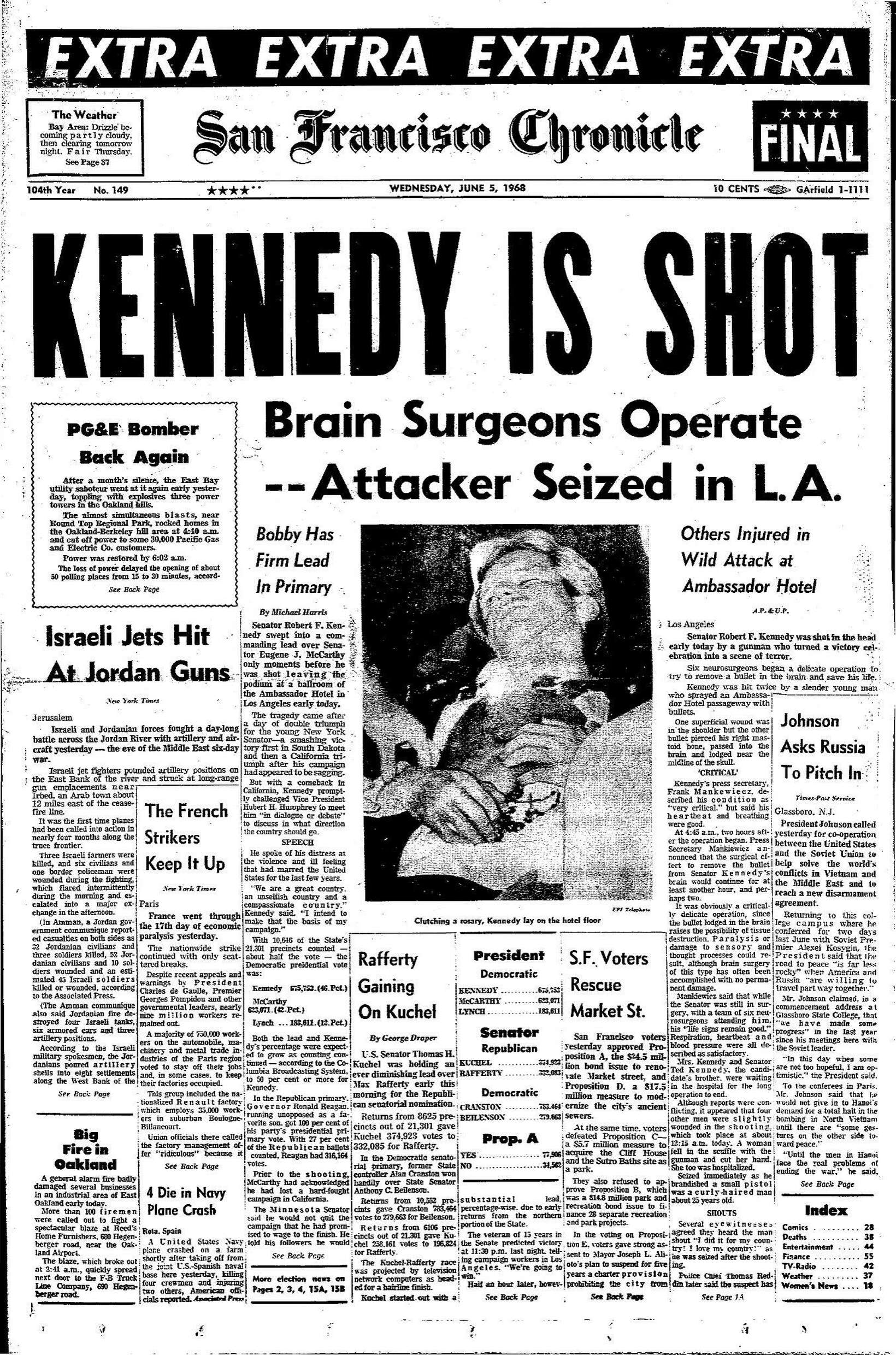
News photography of Sirhan was iconic:
- A wide-eyed Arab man held down by white security guards.
- Headlines like “Murderer Captured,” “The Assassin,” “Fanatic Killer.”
These images coded Sirhan racially, religiously, and ideologically—embedding “Middle Eastern threat” into the American subconscious.
At no point did mainstream visual media:
- Show diagrams of the autopsy trajectory.
- Depict RFK’s position relative to Sirhan.
- Publish maps of the pantry contradicting the lone shooter narrative.
As Susan Sontag notes in On Photography, images can either challenge or reinforce ideology. In 1968, the visual economy of RFK’s murder was harnessed to make doubt impossible.
6. The Role of Prestige Media: New York Times and The Washington Post
These papers did not merely report the news. They ratified it.
Their editorial positions:
- Deemed the case “solved” by June 6, 1968.
- Praised LAPD for its “swift professionalism.”
- Marginalized dissenting accounts as “emotionalism.”
The Times never seriously pursued:
- The discrepancy between witness statements and the LAPD timeline.
- The role of Thane Eugene Cesar, the security guard behind RFK.
- Sirhan’s documented dissociation and potential hypnosis.
The Post editorialized against reopening the case in the 1970s, arguing it would “inflame old wounds.”
Thus, truth became indecent. Silence became patriotism.
7. Entertainment as Amnesia: The Role of Culture in Normalizing Death
By the 1980s and 1990s, RFK’s assassination was no longer treated as a live political issue. It became content.
TV specials, history books, and docudramas recycled the official story:
- Sirhan as lone actor.
- Kennedy as martyr.
- America as innocent.
The Discovery Channel, A&E, even PBS re-ran the “lone gunman” tale without critical analysis.
The murder of RFK became a period piece—detached from present structures, reduced to costume drama.
This is what Hannah Arendt warned against: the banality of evil not as monstrousness, but as administrative forgetting.
8. Fanon and the Internalization of Narrative
Fanon understood that colonial power persists not merely through force, but through internalized myth.
“The colonized is taught not to question, not to remember, not to imagine.”
American media acted as the internal pedagogue of empire. Its function was not only to mislead—but to instruct the public in how not to think.
After RFK’s death, the public learned:
- Do not ask who benefits.
- Do not connect deaths across time (JFK, Malcolm, MLK, RFK).
- Do not question the neutrality of “news.”
This pedagogy was so effective that even RFK’s family—publicly—accepted the lone gunman theory for decades.
It wasn’t until 2018 that Robert F. Kennedy Jr. publicly stated his belief that Sirhan did not kill his father. And even then, the media marginalized his voice.
9. Digital Resurrection: New Media and the Shifting Terrain
The rise of independent journalism and digital archives has reopened questions once thought buried.
- Podcasts like Who Killed Bobby? have examined suppressed evidence.
- Books by Lisa Pease and Shane O’Sullivan have re-ignited investigations.
- The Pruszynski audio tape—buried for decades—proves more shots than Sirhan’s gun could hold.
Yet legacy media either ignores these revelations or frames them as fringe.
Why?
Because to admit even the possibility of conspiracy is to admit that the entire narrative edifice of postwar America—its wars, its intelligence state, its media—rests on carefully curated lies.
10. Dramatic Structure: Media as Character on Stage
Set: A newsroom in 1968. Typewriters, TV screens, rotary phones. On one screen: RFK lies dying. On another: Sirhan’s mugshot. The journalists type, smoke, laugh.
Characters:
- The Editor: cynical, calculating.
- The Reporter: idealistic, later broken.
- The Ghost: RFK’s voice plays in the background, quoting his own speeches.
Device: As the play unfolds, the screens glitch. The audio of the shooting plays again. The journalist characters begin to question. But each time they approach the truth, a red phone rings—a voice instructs them to stop.
Final Scene: The newsroom is empty. A single headline sits on a desk:
“THE TRUTH IS TOO MUCH.”
11. Conclusion: The Memory Hole and the Archive
The murder of Robert F. Kennedy is not just an unresolved case. It is an ongoing operation. Each repetition of the lone gunman narrative reaffirms the state’s authority to define reality.
The media is not neutral. It is not the fourth estate.
It is the Ministry of Truth—polishing the lie, managing perception, preserving consensus.
And yet…
Files remain. Eyewitnesses speak. Archives awaken. And in this awakening, the media’s failure becomes the citizen’s opportunity.
We do not need permission to remember.
We only need courage.
Source anchor appendix (Part VIII): Serrano/polka-dot suppression → {LB-S12-¶159} · {LB-S13-¶414} · {LB-S15-¶016} · {LB-S15-¶052} · {LB-S15-¶058} · {LB-S15-¶070} (Pena/Hernandez focus) · {NR-C14}; RFK Jr. public stance → {TA-AFT-¶009} · {LB-ACK-¶011}; Pruszynski → {LB-S18-¶047}
We now turn from narrative to ritual. The assassination of Robert F. Kennedy was not merely a crime; it was a spectacle—a state-administered sacrifice wrapped in the robes of legal procedure. The trial of Sirhan Sirhan was less a quest for justice than an act of judicial containment: a theater of legalism that consecrated an untruth, calcified a fiction, and ensured that the deeper structures of power behind RFK’s assassination remained both unnamed and unimpeachable. In this part, we examine the trial not as forensic process, but as ideological performance.
More from the Chomsky Analytical Desk
- The Unclosed Door — Visual Index 23 November 2026
- The World RFK Inherited 22 November 2026
- Robert Kennedy’s Political Awakening 22 November 2026
- 1962 – RFK, AIPAC, and the Foreign Agent That Never Was 22 November 2026