
The Unclosed Door · RFK series
Fanon and the Death of Democratic Sovereignty – Colonial Logic at Home
Part VII of The Unclosed Door
1. Introduction: From Algeria to Los Angeles
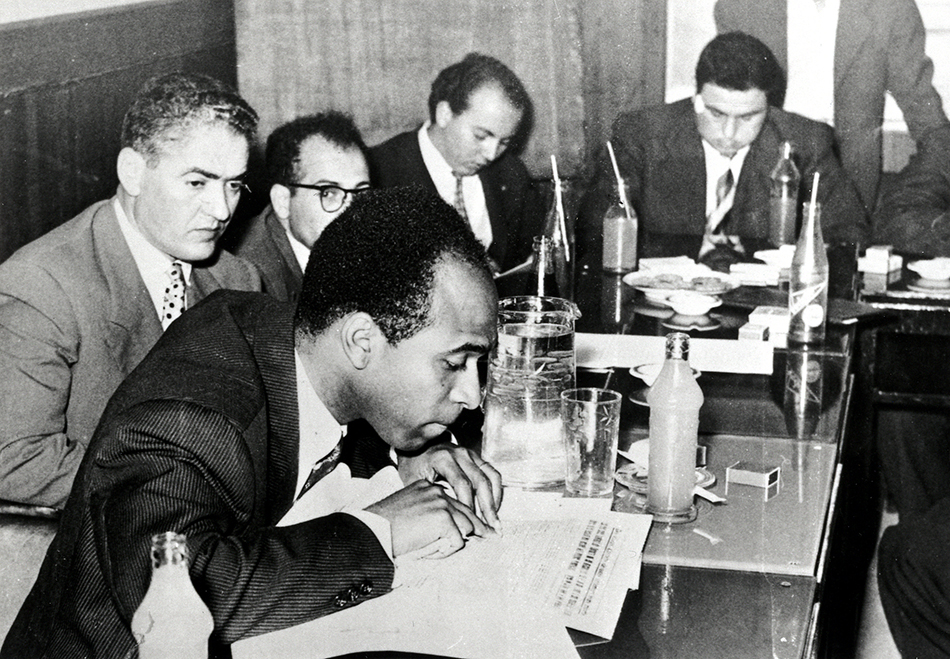
The thought of Frantz Fanon is almost never invoked in discussions of the RFK assassination. This is not an oversight—it is a symptom. Fanon was a revolutionary psychiatrist, a theorist of colonial violence, and a diagnostician of systems that kill in order to remain coherent. His insights were forged in blood and contradiction—Algeria, Congo, Martinique—and yet they echo, with astonishing relevance, in the fluorescent death-chamber of the Ambassador Hotel.

To apply Fanon to RFK is not to stretch theory beyond its limits. It is to restore clarity to an event shrouded in liberal mourning. For Fanon, every colonial system is haunted by its internal contradictions—and every reformer who tries to humanize that system becomes, eventually, a necessary sacrifice.
Robert Kennedy was not a colonizer. But he had once been one. And when he began to defect—publicly, spiritually, and politically—the colonial apparatus responded with automatic, programmatic violence.
2. The Manichaean Structure of the American Empire
In The Wretched of the Earth, Fanon identifies the core structure of colonial order: the Manichaean world—a dualistic geography in which “the colonizer and the colonized inhabit different zones, different realities, different ontologies.”
The colonizer’s zone:
- Clean, illuminated, protected by law and police.
- Built on extraction, surveillance, denial.
- Populated by the agents of order.
The colonized’s zone:
- Dark, dirty, criminalized, unprotected.
- Marked by precarity and symbolic degradation.
- Defined only in relation to the dominant order.
Fanon was writing of French Algeria. But the same binary is replicated within the American empire—especially in 1968:
- White suburbs vs. Black inner cities.
- Ivy League political dynasties vs. unemployed urban youth.
- Law and order vs. civil unrest.
RFK’s assassination took place in the middle of this divide. He had entered the “other zone”—not just symbolically, but literally:
- Visiting sharecroppers in Mississippi.
- Standing with Cesar Chavez.
- Calling out the racism of America’s legal system.
To the logic of empire, this made him not a reformer—but a traitor to the colonial hierarchy.
3. The Colonized Intellectual and the Dangerous White Liberal
Fanon describes two types of colonial intermediaries:
- The colonized intellectual who mimics the colonizer, suppressing his own culture and identity.
- The liberal colonizer who imagines himself as a bridge, but never surrenders his dominion.
What made RFK dangerous is that he was transcending both roles.
He was:
- No longer an enforcer (as he had been under McCarthy and Hoover).
- No longer a mere sympathizer (as many Northern liberals were).
- Becoming a revolutionary threshold figure—one who opens space for the wretched to speak in their own name.
Fanon warns: when such a figure emerges—someone with credibility in both worlds, someone who could unite the ghetto and the state—the colonial system will recognize it as an existential threat.
RFK’s campaign was not just a political movement. It was the beginning of decolonization from within.
4. Colonial Violence: Preemptive, Structural, Disavowed
Fanon identifies a key feature of colonial violence: it is not reactive. It is preemptive.
“Colonialism is not satisfied merely with holding a people in its grip… it turns to the past of the oppressed people, and distorts, disfigures, and destroys it.”
(The Wretched of the Earth)
RFK’s presence in 1968 disrupted this pattern. He didn’t just propose new policies—he reminded the American people that a different past was possible:
- That JFK had tried to prevent Israel from going nuclear.
- That the CIA had overstepped in Guatemala and Cuba.
- That civil rights wasn’t just legalism—but liberation.
He was attempting to restore the erased memory of democratic sovereignty.
So the system responded in the only way it can: by erasing him in return.
His death was not a glitch—it was a programmed necessity.
5. Sirhan Sirhan: The Colonized Body as Executioner
The choice of Sirhan as the alleged assassin is not random. Fanon explains how the colonized subject internalizes violence—not as revolution, but as misdirection.
Sirhan was:
- A Palestinian refugee, displaced by the Nakba.
- Living in a racialized, alienating America.
- Shown photographs of RFK wearing a yarmulke at a synagogue, framed as a Zionist.
Sirhan’s notebooks show hypnotic repetition, not political analysis:
“RFK must die… RFK must die… before June 5…”
Whether he fired the fatal shots is almost irrelevant in Fanon’s framework. His role was symbolic: to re-establish the racial boundary. To show that the colonized, if they rise, will do so irrationally, violently, self-destructively.
This is the genius of colonial psy-ops: to take the figure of justified dissent, and weaponize him against the wrong target.
Sirhan becomes the mirror in which the American empire sees the consequences of its own hypocrisy—but blames the Other.
6. The Assassination as Ritual: Sovereignty Seized and Suppressed
In Fanon’s final chapters, he theorizes decolonization as a sacred rupture—a moment when the colonized reject not only domination but the very ontological schema of the colonizer.
RFK’s campaign, in 1968, was activating this moment:
- Reclaiming the political system from the intelligence agencies.
- Proposing nonviolence not as passivity but as dignity.
- Speaking to, and with, the poor—not about them.
In this sense, the assassination is a counter-ritual. A performance of systemic dominion.
The scene of his death—the hotel pantry—becomes a colonial theater:
- Closed, surveilled, secured.
- White bodies falling, brown body arrested.
- Evidence altered, truth erased.
This is not politics. This is ritual containment. A reminder that no matter how far into the heart of power a liberated subject might travel, the colonial system will always have a bullet waiting.
7. The Post-Colonial Elite and the Closure of Possibility
Fanon warned of the post-independence native bourgeoisie—a class that mimics the colonizer’s style while abandoning the masses.
After RFK’s death, what came?
- Nixon’s law-and-order regime.
- The rise of neoliberalism under Carter and Reagan.
- The collapse of Black radical movements under COINTELPRO.
- The entrenchment of AIPAC, the CIA, and the Pentagon as de facto branches of government.
RFK’s death was not merely an interruption. It was a redirect—a closing of the possible.
No one like him has emerged again—because the system now ensures that such figures are discredited, marginalized, or murdered before they reach critical mass.
8. Dramatic Rendering: The Fanonian Stage
Set Design: A split stage. One half: a psychiatric hospital, Sirhan being hypnotized. The other: a balcony in Mississippi, RFK with Black children. The lights flicker back and forth.
Sound: Fanon’s words in voiceover:
“The colonized man is an envious man.”
Actors:
- RFK plays both priest and rebel, healer and heretic.
- Sirhan appears not as villain, but as ghost—adrift in fog.
- A “chorus of the disavowed” speaks lines from King, Malcolm, Lumumba, and Fanon.
Climax: RFK stands alone, in white, facing a firing squad made up of masked figures. Each mask bears the emblem of an institution: CIA, FBI, Pentagon, AIPAC, CBS.
He looks at them. He speaks:
“You are not the future. You are the past in drag.”
They fire. Light fades.
9. Conclusion: Fanon in the Imperial Core
Frantz Fanon wrote to the periphery—his audience were the colonized of Africa, Asia, the Caribbean. But his insights now return to the heart of the empire.
America, in killing Robert Kennedy, enacted what Fanon knew was always inevitable:
- That a colonial system cannot be reformed.
- That even its best children will be sacrificed if they choose the wrong side.
- That healing and justice cannot coexist with covert rule.
RFK was a liminal figure. He crossed the line between law and truth. Between power and mercy. Between being the colonizer—and the beginning of its end.
And the system responded, as Fanon would have expected: with ritual execution, followed by narrative closure.
But the narrative has reopened.
We are reading it now.
Shall I proceed?
Source anchor appendix (Part VII): Fanon framing — theoretical. Sirhan's Palestinian refugee background and the "Zionist" framing of RFK → {WJ Parts I–II} · {FT}; Sirhan's notebooks and trance states → {MD-C12} · {LB-S22}
More from the Chomsky Analytical Desk
- The Unclosed Door — Visual Index 23 November 2026
- The World RFK Inherited 22 November 2026
- Robert Kennedy’s Political Awakening 22 November 2026
- 1962 – RFK, AIPAC, and the Foreign Agent That Never Was 22 November 2026