
The Unclosed Door · RFK series
The Polka-Dot Dress and the Female Operative – MKUltra, Witness Suppression, and the Phantom at the Scene
Part XIV of The Unclosed Door
1. Introduction: A Woman, A Pattern, A Lie
The first time she appeared, she was running.
She was seen bolting from the Ambassador Hotel’s kitchen area moments after Robert F. Kennedy was shot.
She was young. Attractive. Light-skinned. And she was wearing a white dress with black or dark blue polka dots.
As she fled, she shouted to a male companion:
“We shot him! We shot Kennedy!”
That moment should have upended the case.
It should have transformed the investigation from a lone gunman hypothesis to a coordinated assassination.
Instead, it became the starting point for a campaign of erasure, ridicule, and psychological destruction aimed not at the perpetrators—but at the witnesses.
The “girl in the polka-dot dress” is not a side note.
She is the smoking mirror—the place where all lines of conspiracy intersect: psychological manipulation, operational deception, witness suppression, and gendered intelligence work.
2. Sandra Serrano: The Witness Who Knew Too Much
The most widely cited account of the polka-dot woman comes from Sandra Serrano, a 20-year-old Kennedy campaign volunteer.
According to her recorded interview with LAPD Sergeant Paul Sharaga:
- Serrano saw a woman in a polka-dot dress accompanied by two men—one possibly Sirhan—on a stairwell outside the ballroom.
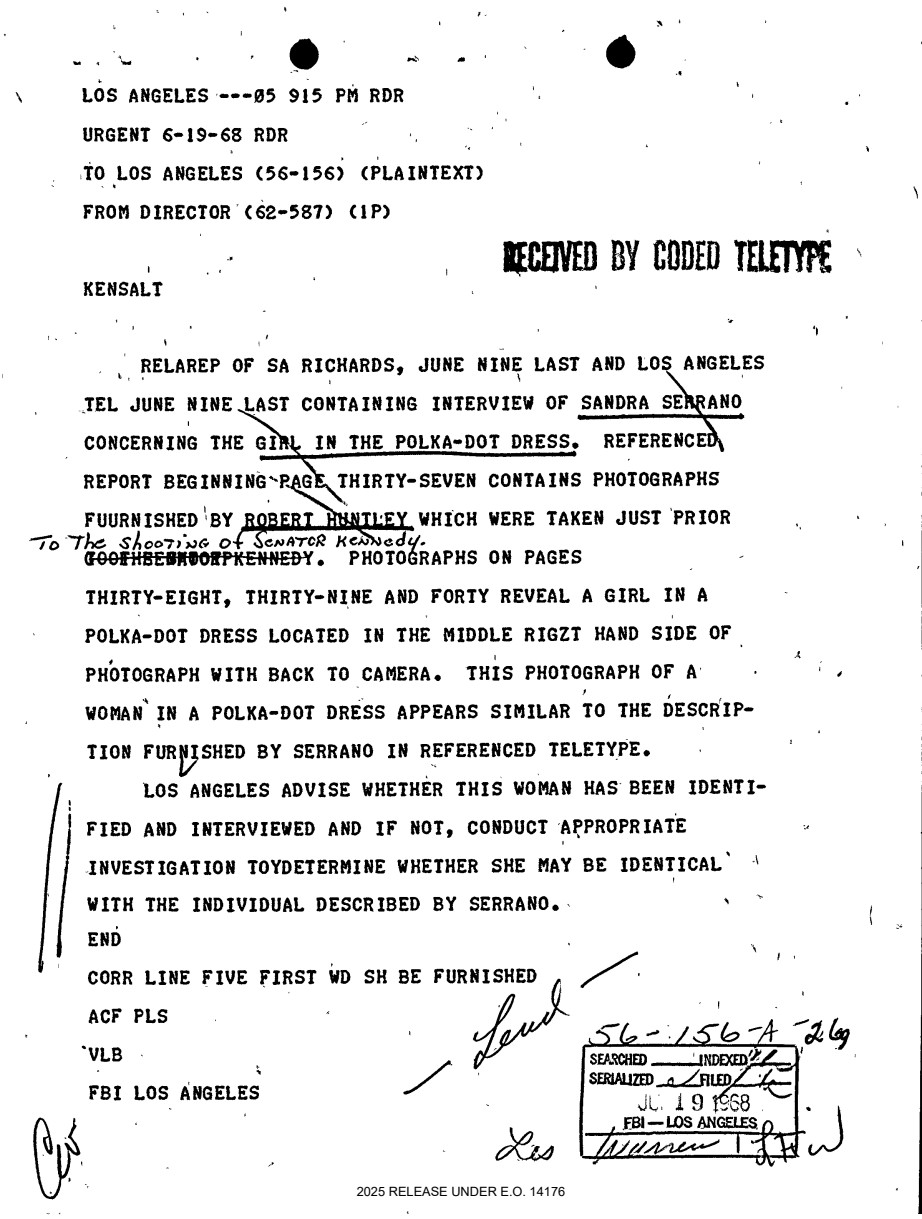
- After the shooting, she saw the same woman run past her, exclaiming:
“We shot him! We shot Senator Kennedy!”
Serrano’s account was detailed, immediate, and spontaneous. She had no reason to fabricate, no political motive, and no prior media exposure.
Yet LAPD subjected her to intense coercion:
- She was interrogated by Hank Hernandez, a former Army intelligence officer and LAPD polygraph expert.
- Hernandez berated and manipulated her, suggesting repeatedly that she was “confused” or “making it up.”
- Serrano eventually recanted—under duress.
Transcripts of the interview reveal Hernandez’s tactics:
- Gaslighting.
- Suggestion of mental instability.
- Personal shaming.
Serrano later reaffirmed her original account.
But the damage was done.
She was smeared. Discredited. Forgotten.
3. Multiple Witnesses: A Pattern of Consistency
Sandra Serrano was not alone.
At least eleven other witnesses reported seeing a woman matching the polka-dot description:
- Vincent DiPierro, RFK campaign worker, saw a girl in a white dress with black dots standing next to Sirhan moments before the shooting. She appeared to nudge him forward.
- Evan Freed, a photographer, confirmed the woman’s presence near Sirhan and described her as “calm, alert, and out of place.”
- Nina Rhodes-Hughes, a TV actress and Kennedy supporter, testified in 2012 that she saw multiple shooters and a woman matching the polka-dot description at the scene.
- Frank Burns, ABC sound technician, saw a woman matching the description near the crime scene acting strangely.
Despite these accounts:
- LAPD downplayed, omitted, or destroyed their testimonies.
- No composite sketch was circulated.
- No suspect fitting her description was arrested or interrogated.
- The LAPD concluded “she didn’t exist.”
In effect, she became an anti-witness: the more she was seen, the more she had to be denied.
4. Who Was She? Theories and Profiles
The polka-dot woman remains unidentified. But multiple plausible profiles emerge:
4.1 CIA Asset / MKUltra Courier
- The use of female operatives in MKUltra programs is well-documented.
- Women were trained to serve as triggers, emotional cues, or handlers in dissociative programming.
- In Sirhan’s case, such a figure could have functioned as:
- A visual anchor—a stimulus associated with a pre-hypnotic script.
- A cue-giver—delivering the final signal for action.
- A post-operation exfiltrator—providing confusion and redirection.
She was seen nudging Sirhan moments before the shooting, suggesting active participation.
4.2 Army Intelligence Operative
LAPD had deep links with military intelligence, especially through officers like Hank Hernandez and Manuel Pena, both of whom had overlapping histories with U.S. counterintelligence in Latin America.
Polka-dot woman could have been part of a multi-agency hit team, planted to orchestrate Sirhan’s movements and disorient observers.
4.3 Controlled Civilian / Disinformation Agent
Another theory is that she was a trained civilian asset—someone recruited by intelligence services and assigned a simple, deniable role in a psychological operation.
Her presence could have served multiple strategic functions:
- To draw attention toward a “Palestinian conspiracy.”
- To seed confusion through inconsistent identification.
- To test the response time and suppression ability of local law enforcement.
5. Patterned Behavior: A Psychological Profile
Witnesses consistently described the polka-dot woman as:
- Emotionally flat.
- Detached from the chaos.
- Calm in the face of violence.
- Not hysterical, not shocked, not fearful.
This is consistent with trained behavioral conditioning:
- MKUltra documents detail experiments on affect suppression, creating agents who can perform under duress with complete dissociation.
- Dr. George Estabrooks, an early hypnosis expert, claimed such female “dolls” were created for espionage.
Her post-shooting exclamation—“We shot Kennedy!”—was likely intentional disinformation:
- Spoken just loud enough for witnesses to hear.
- Designed to shock, distract, and divert pursuit.
In this reading, she was not fleeing in panic—but completing a script.
6. LAPD and the Erasure Protocol
The Los Angeles Police Department’s response to the polka-dot woman was not investigatory. It was punitive.
- They suppressed witness reports.
- Destroyed composite sketches and photographic leads.
- Filed internal memos discrediting credible witnesses.
- Never pursued her as a suspect, accomplice, or witness.
Their actions mirrored standard cover-up tactics:
- Control the flow of information.
- Discredit high-credibility witnesses (like Serrano, DiPierro).
- Overwhelm the public with conflicting reports.
- Close the case quickly with no loose ends.
The official report concluded she was “a figment of imagination.”
This was not just investigative failure.
It was counterintelligence discipline.
7. The Gendered Logic of Covert Action
The use of women in covert operations is not anomalous—it is strategic.
In counterintelligence and psychological warfare:
- Women are deployed to neutralize suspicion.
- They function as emotional regulators, inducing trust or distraction.
- Their testimony is easier to discredit in a sexist culture.
Fanon understood this dynamic in colonial warfare:
“The colonizer uses the colonized woman not as a person, but as a vessel. Her purpose is not to speak—but to carry the message.”
The polka-dot woman carried the message that:
- The assassination was emotional.
- It was impulsive.
- It was foreign and anti-Semitic.
Then she vanished.
Her real name is unknown.
But her function was precise.
8. The Symbolism of the Dress
The polka-dot dress is more than wardrobe. It is semiotic camouflage.
- A symbol of innocence.
- A visual distraction.
- A recurring motif in surveillance culture.
In postmodern theory, the polka-dot is:
- A pattern without center.
- A field of fragmentation.
- A signal that hides itself through repetition.
She was not dressed to be remembered.
She was dressed to be doubted.
In psychoanalytic terms, the dress becomes a floating signifier—projected upon by each witness, impossible to fix.
But that’s the point.
She wasn’t supposed to be solved.
She was supposed to destroy coherence.
9. Theatrical Rendering: Polka-Dot as Portal
Set: A kaleidoscope of memory fragments. Witnesses stand in spotlights. Each describes the woman slightly differently.
Act I: Sandra Serrano recounts her sighting. She is interrupted by LAPD agents with tape recorders. The lights dim.
Act II: DiPierro sees the woman with Sirhan. He tries to intervene. She smiles and disappears behind a curtain.
Act III: A shadowplay. The woman stands center stage. Her dress ripples like water. Voices echo: “We shot Kennedy…”
Final Image: The dress is left on a mannequin. A sign reads:
“This pattern is no longer in production.”
10. Conclusion: The Woman as Weapon
The girl in the polka-dot dress was not a figment. She was not a mistake. She was not an illusion.
She was a tactical insertion—engineered to guide, disrupt, distract, and disappear.
Her role was never to be explained.
It was to make explanation impossible.
And in that impossibility, the case would close.
Sirhan would be convicted.
RFK would be buried.
And a woman no one would name would remain the last person seen leaving the scene.
She didn’t just vanish.
She was vanished.
And in doing so, she left behind the clearest fingerprint of all.
Source anchor appendix (Part XIV): polka-dot girl sightings and Serrano's coerced recantation → {LB-S12-¶159} · {LB-S13-¶069} · {LB-S13-¶409} · {LB-S13-¶414} · {LB-S15-¶016} · {LB-S15-¶052} · {LB-S15-¶058} · {LB-S15-¶070} · {NR-C14}; full digest → the “Polka-dot dress” source digest (259 anchored paragraphs)
More from the Chomsky Analytical Desk
- The Unclosed Door — Visual Index 23 November 2026
- The World RFK Inherited 22 November 2026
- Robert Kennedy’s Political Awakening 22 November 2026
- 1962 – RFK, AIPAC, and the Foreign Agent That Never Was 22 November 2026