
The Unclosed Door · RFK series
Sirhan Sirhan – The Manufactured Assassin
Part IV of The Unclosed Door
1. Introduction: A Weaponized Void
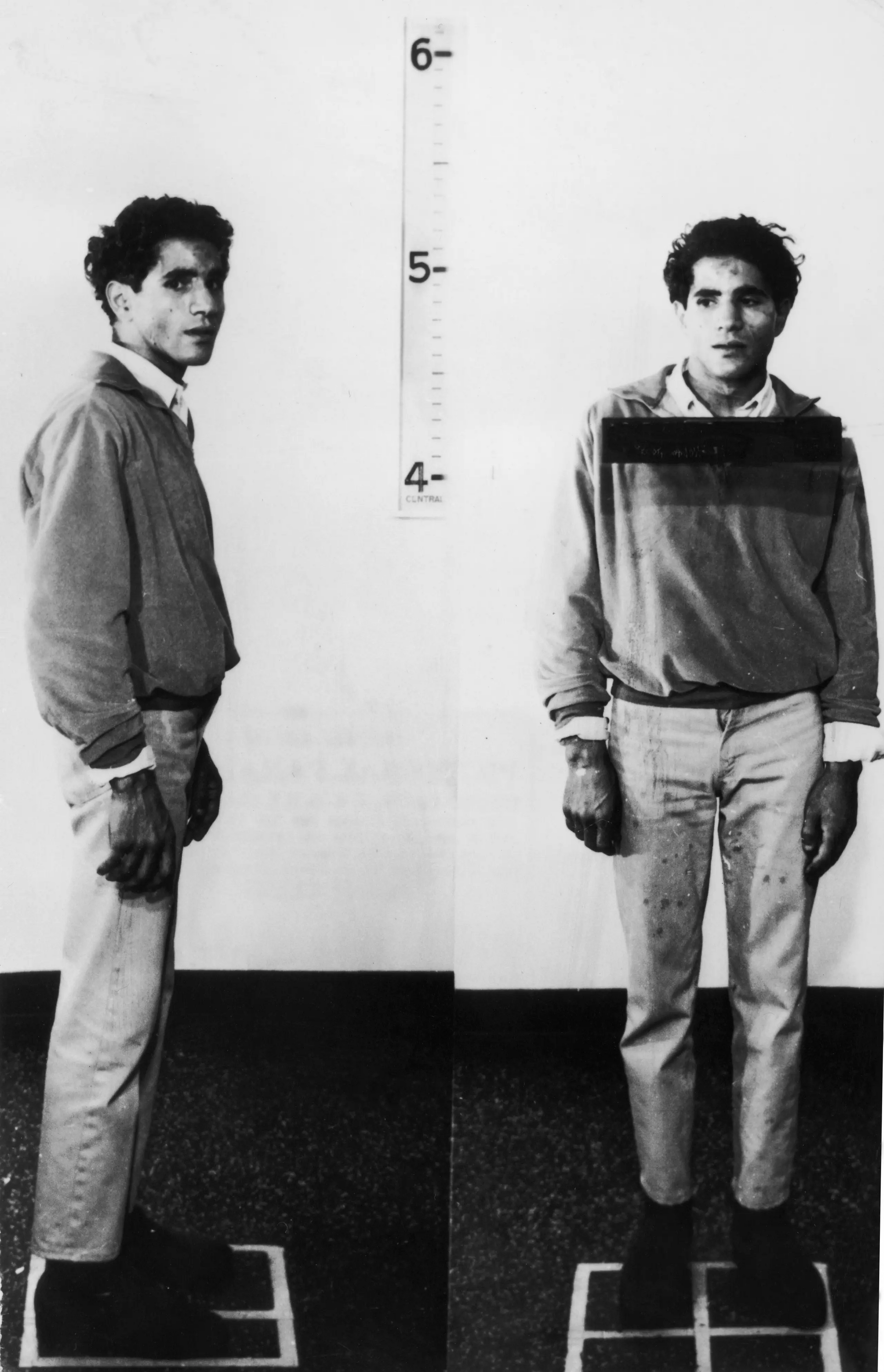

Sirhan Bishara Sirhan did not kill Robert F. Kennedy.
This is not merely a legal claim—it is a metaphysical assertion. The historical Sirhan, born in Jerusalem in 1944, raised in the rubble of war and dislocation, became in the United States a figure suspended between myth and non-being. His role in RFK’s assassination was not that of a political agent, but of a symbolic decoy. In Fanon’s terms, he was not a subject—but a prop deployed by a colonial regime to script its own absolution.
He was made.
What follows is not a defense of Sirhan. It is an autopsy of his transformation: from traumatized immigrant to hypnotized “assassin”—the puppet whose string-pullers remain invisible.
2. The Anatomy of a Patsy
Sirhan was arrested holding a .22 caliber Iver Johnson pistol, still warm, moments after RFK was shot in the Ambassador Hotel pantry. He appeared dazed, confused. Witnesses claimed he had fired toward RFK, but not from behind—the direction from which all fatal shots entered the senator’s head.
The LAPD, under pressure to close the case, ignored the ballistic anomalies. The media amplified the narrative of “the Palestinian killer,” forming an interpretive frame before the evidence was examined.
Sirhan’s public persona was created within 48 hours. He was:
- An angry Arab,
- Avenging the U.S.–Israel alliance,
- Acting alone.
But there was one problem: he had no memory of the shooting.
He said so immediately. He said so during the trial. He says so today.
3. The Notebooks: Script or Symptom?
In Sirhan’s apartment, police found notebooks with repetitive, hypnotic writing:
“RFK must die… RFK must die… before June 5…”
This was presented as a smoking gun. But to any trained psychiatrist or intelligence researcher, it read like automatism: a classic symptom of dissociation, not premeditated planning.
The handwriting slanted, repetitive, obsessive, with gaps in syntax and logic. It mirrored patterns found in individuals under hypnosis or psychotic breakdown.
What went unexamined publicly—yet flagged by multiple defense psychologists—was that these writings resembled programmed scripts.
This leads us directly into the black ops heart of Cold War America: MKUltra.
4. MKUltra: The State’s Shadow Theater
Between 1953 and 1973, the CIA conducted covert research into mind control under the codename MKUltra. Thousands of subjects—often unwitting—were drugged, hypnotized, electroshocked, and subjected to dissociative conditioning in an attempt to create “programmable” human assets.
One of the explicit goals: the creation of an “involuntary assassin.”
Declassified documents refer to:
- Amnesia induction
- Double consciousness
- Hypnotic suggestion for violent action
- “Trigger phrases” to activate pre-programmed behavior
Dr. George Estabrooks, a leading hypnotist consulted by the military, claimed publicly that such programs were successful as early as 1947.
By 1968, the CIA had perfected split-consciousness training protocols that allowed a subject to perform actions without conscious awareness—and then forget them.
Sirhan was a textbook case.
5. The Psychiatric Reports: Red Flags Ignored
At trial, multiple defense experts testified that Sirhan was not mentally competent in the legal sense—not because he was insane, but because he could not consciously recall or explain his own actions.
Psychiatrists including Dr. Bernard Diamond and Dr. Daniel Brown noted:
- Sirhan could be placed into hypnotic trance within seconds.
- Under hypnosis, he re-enacted the shooting automatically.
- When brought out of trance, he was confused and disoriented.
Dr. Diamond told the court:
“He was programmed. He was used.”
But the prosecution dismissed this as “science fiction.” The judge refused to admit detailed MKUltra evidence. The jury, uninformed and unqualified to interpret dissociation, convicted.
The hypnotized man was executed legally—his programmers were not even named.
6. The Real Kill Shot: Ballistics and Blindness
The fatal shot entered RFK behind his right ear, at point-blank range (less than one inch). All eyewitnesses agreed: Sirhan was never behind Kennedy. He was in front, several feet away.
Independent ballistics experts—including Dr. Cyril Wecht and Dr. Robert Joling—concluded:
- More bullets were fired than Sirhan’s gun could hold.
- Shots came from different angles and distances.
- The official autopsy contradicted LAPD diagrams.
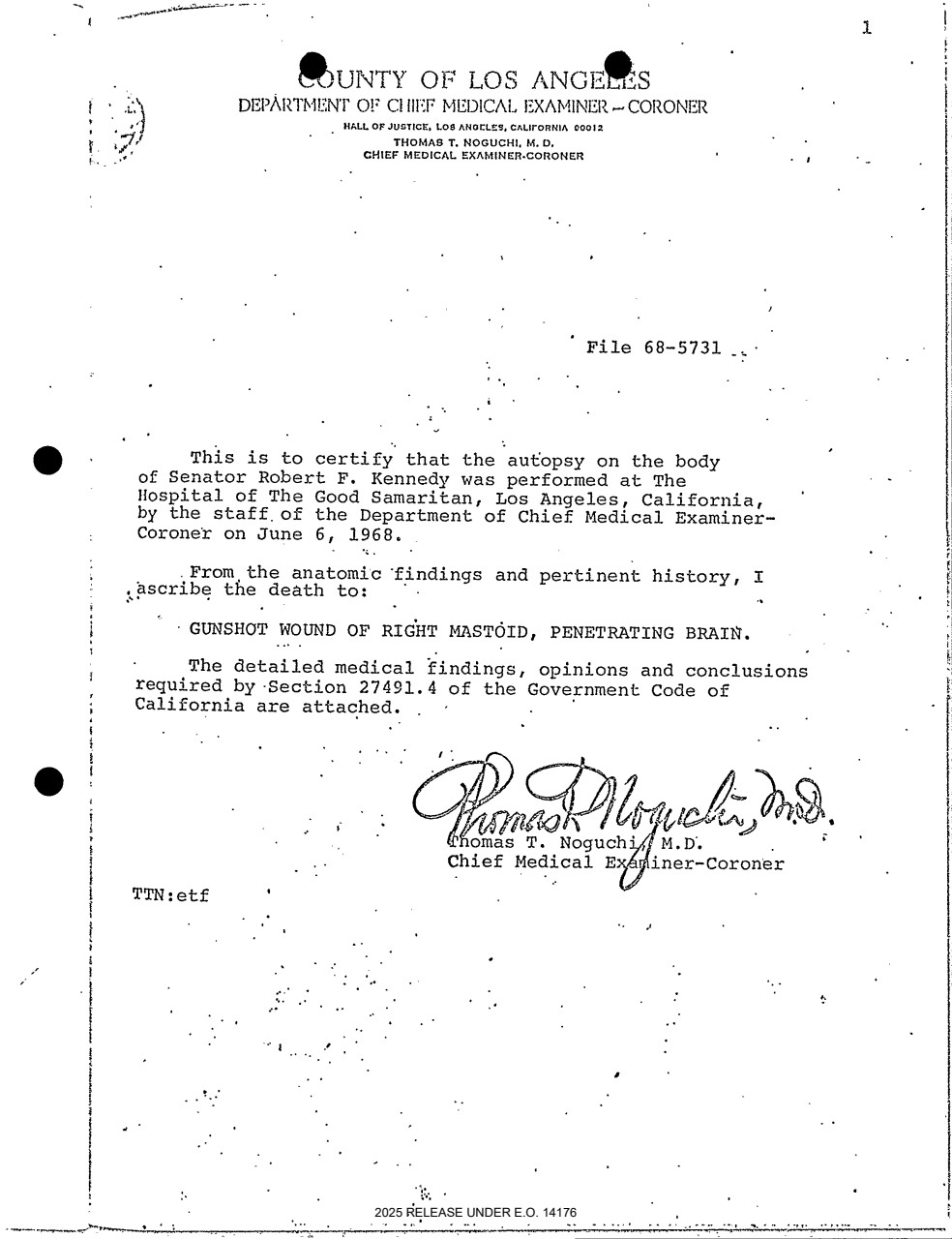
In any ordinary case, this would trigger retrial. But this was not an ordinary case—it was a managed narrative.
Sirhan’s role was sacrificial: to absorb guilt, redirect attention, and foreclose deeper investigation.
7. Fanon and the Function of Sirhan
Frantz Fanon wrote of the colonized subject:
“He is overdetermined from the outside. He is a constructed image of what the colonizer needs him to be.”
Sirhan, the Palestinian, functioned perfectly within the American colonial unconscious. He was Other. Angry. Religious. Semitic. Displaced. In killing RFK, he killed “peace.” In appearing dazed, he confirmed the irrationality of anti-Zionism. In forgetting, he made himself the perfect absence.
His function was not to murder, but to symbolize:
- Don’t question U.S. policy in the Middle East.
- Don’t resist Israeli influence.
- Don’t attempt structural change.
He became a living warning.
8. Witness Tampering and Evidence Destruction
Key witnesses—including Sandra Serrano, who saw a woman in a polka-dot dress shout “We killed him!”—were harassed by LAPD, threatened, or ignored.
- Audio recordings disappeared.
- Bullet holes were patched without analysis.
- The crime scene was cleaned before all evidence was catalogued.
As in the JFK assassination, official agencies moved swiftly—not to uncover, but to seal. The narrative had to be coherent, even if the truth was not.
And Sirhan, locked in a trance of his own mind’s rupture, became the center of a meticulously curated falsehood.
9. Dramatic Construction for Theatrical Use
- Stage Architecture: A split mind made visible—Sirhan’s “conscious” self on one side of the stage; his hypnotized self on the other. A beam of light connects them only when “trigger phrases” are spoken.
- Sound Design: A monotonous metronome ticking behind dialogue. Every time Sirhan speaks, it falters—suggesting that even speech is uncertain, fractured, borrowed.
- Chorus: A panel of voices—psychiatrists, CIA documents, MKUltra victims—speak in clinical monotone, narrating the process of conditioning.
- Symbol: A mirror that never reflects Sirhan’s face fully. Always fragmented.
10. Conclusion: A Mirror, Not a Man
Sirhan Sirhan was not a lone gunman. He was not even, in the deepest sense, a gunman.
He was a mirror held up to the American psyche—a mirror that said: this is what we do to those who defy the script. This is what it looks like to deconstruct a man, reconstruct him as a weapon, and destroy him before he understands what he’s become.
And the real killers—those who needed RFK gone before he could reconstitute American sovereignty—never needed to be seen.
They had Sirhan.
Source anchor appendix (Part IV): ballistics/distance claims → {LB-S14-¶039} (Noguchi: 2–3 inches max) · {MD-EPI-¶026} ("an inch or less") · {NR-C01}; Sirhan never behind RFK → {NR-C01} · {WB-C06}; notebooks/automatic writing/AMORC → {MD-C12-¶140} · {LB-S22-¶046} · {LB-S22-¶063} · {LB-S22-¶084} (incl. the upside-down "Electronic equipment" line in another hand); Diamond hypnosis findings → {MD-C12-¶221} · {MD-C12-¶235}; Serrano → {LB-S12-¶159}
More from the Chomsky Analytical Desk
- The Unclosed Door — Visual Index 23 November 2026
- The World RFK Inherited 22 November 2026
- Robert Kennedy’s Political Awakening 22 November 2026
- 1962 – RFK, AIPAC, and the Foreign Agent That Never Was 22 November 2026