
Ox.News Report
The Silencing of the Titan: Philip Graham and the Crisis of the American Press
The final year of the Washington Post’s publisher: a breakdown, a speech in Phoenix that named names, and a death that closed the question.
This report constitutes an exhaustive historical and forensic reconstruction of the final year in the life of Philip Leslie Graham, the publisher of The Washington Post and a seminal figure in the 20th-century American political-intelligence establishment. Spanning the critical period from August 1962 to September 1963, this analysis synthesizes archival records, biographical accounts, and intelligence historiography to illuminate the intersection of Graham’s severe psychiatric decline with his position as a founding architect of the CIA’s "Operation Mockingbird."
The investigation focuses on three primary dimensions: (1) the disintegration of Graham’s personal and professional life amidst a manic-depressive crisis and an affair with journalist Robin Webb; (2) the geopolitical and intelligence ramifications of his erratic behavior, specifically his public exposure of President John F. Kennedy’s illicit affairs and his threats to dismantle the CIA’s media assets; and (3) the forensic and circumstantial anomalies surrounding his death by shotgun on August 3, 1963, and the subsequent transfer of media power to his widow, Katharine Graham. By integrating details regarding the "Special Branch" of Army Intelligence and the "Mary Pinchot Meyer" connection, this report evaluates the hypothesis that Graham’s death was a stabilizing event for the national security state, resolving a crisis that threatened to expose the deep structural collusion between the American press and the intelligence community.
Part I: The Architecture of Influence (Context and Background)
1.1 The Man in the Center
To understand the magnitude of the crisis that unfolded between August 1962 and August 1963, one must first appreciate the singular position Philip Graham occupied in the American hierarchy. He was not merely a newspaper publisher; he was a nexus point for the flow of information and power in the Cold War capital. As the son-in-law of Eugene Meyer, he had transformed The Washington Post from a struggling local daily into a national political force. He owned Newsweek, a purchase he had orchestrated to expand his influence globally. But his power was not derived solely from ink and paper; it was rooted in the clandestine soil of the intelligence community. Graham’s credentials were established during World War II. In
1944, he was recruited into the "Special Branch," a super-secret intelligence unit within the Military Intelligence Service (G-2) run by Colonel Alfred McCormick.1 This unit was distinct from standard military intelligence; it was the clearinghouse for ULTRA and MAGIC intercepts—the decrypted communications of the German and Japanese high commands.3 Admission to the Special Branch required the highest level of security clearance and placed Graham in the company of men who would later form the backbone of the Central Intelligence Agency. He worked alongside figures like John K. Singlaub, Ray S. Cline, and Richard Helms—men who would become titans of the Cold War shadow world.2 This background is critical. When Graham spoke, he did not speak as a speculative journalist; he spoke as an insider with a trained understanding of signals intelligence, covert operations, and the strategic value of information. He was, in the words of later historians, "one of the architects" of the CIA’s infiltration of the American media, a program known by the codename Operation Mockingbird.5
1.2 The "Mighty Wurlitzer" and the Georgetown Set
By 1962, the machinery Graham helped build was humming. CIA official Frank Wisner, a close friend and neighbor of Graham in Georgetown, referred to the agency’s covert influence network as his "Mighty Wurlitzer," a metaphor for a console capable of playing any propaganda tune the agency desired across the global stage.5 Graham was a key operator of this console. It was "widely known," according to a former CIA deputy director, that "Phil Graham was someone you could get help from".5
This help took material forms: providing cover for CIA operatives posing as journalists, suppressing stories detrimental to national security, and facilitating the recruitment of reporters. Records indicate Graham participated in meetings where the "availability and prices of journalists were discussed," with the cynical observation that reporters could be bought for "a couple hundred dollars a month".5
This professional collusion was cemented by social intimacy. The "Georgetown Set"—comprising Graham, Wisner, diplomat Chip Bohlen, propagandist Joseph Alsop, and others—functioned as an unofficial politburo. They lived in the same neighborhood, drank the same whiskey, and shared a consensus view of the American Century. However, by the summer of 1962, the cohesion of this group was threatened by the disintegration of its most volatile member.
Part II: The Unraveling (August 1962 – December 1962)
2.1 The Onset of the Crisis
In August 1962, the latent bipolar disorder (then termed manic depression) that had plagued Graham for years entered a severe and sustained acute phase. The trigger—or perhaps the symptom—was his deepening infatuation with Robin Webb, a young Australian journalist working as a stringer for Newsweek in Paris.6
Graham had met Webb during his frequent trips to Europe to oversee Newsweek’s operations. What began as a dalliance quickly metastasized into an obsession. By late summer 1962, Graham was spending less time in the Post’s newsroom and more time in Paris or New York with Webb. He set her up in a house in Washington and reportedly bought a farm for their use, signaling an intent to integrate her into his life permanently.2
The manic phase of his illness manifested as hyper-sexuality, extreme irritability, and grandiose behavior. He began to drink heavily, exacerbating his chemical imbalance.7 In social settings, he turned on his wife, Katharine Graham. The woman who controlled the voting shares of the Washington Post Company became the target of vicious, public verbal abuse. He belittled her intelligence, mocked her appearance, and openly flaunted his relationship with Webb, often referring to her as "Cuddles" in front of the Georgetown elite.5
2.2 The Cuban Missile Crisis (October 1962)
While his personal life was collapsing, Graham remained a player in the highest stakes game of the century. In October 1962, the world stood on the precipice of nuclear war during the Cuban Missile Crisis. Graham was a close confidant of both President John F. Kennedy and Vice President Lyndon B. Johnson.9 During the crisis, Graham was privy to sensitive information regarding the Soviet missile sites. His manic energy, rather than disqualifying him, initially seemed to align with the frenetic pace of the crisis. He advised the administration on media management, ensuring the Post supported the blockade (quarantine) strategy. However, the extreme stress of October 1962 poured fuel on the fire of his psychosis. The proximity to absolute power and absolute destruction seemed to unmoor him further from social conventions. He held secrets that could destroy the world, and his discretion was eroding by the day.
2.3 Christmas Eve 1962: The Break
The situation reached a domestic terminal point on December 24, 1962. Katharine Graham answered a telephone extension at their home to find Philip and Robin Webb on the line, speaking in intimate, explicitly romantic terms.6
The discovery forced the confrontation. Rather than retreat, Philip went on the offensive. He announced his intention to divorce Katharine and marry Robin Webb. More dangerously, he declared his intent to purchase the controlling interest in the Washington Post Company, effectively staging a hostile takeover of the Meyer family legacy.1
This was not just a marital dispute; it was a corporate and political crisis. If Philip Graham succeeded, the Washington Post—the "liberal bible" of the capital—would be controlled by a manic-depressive publisher influenced by a young foreign mistress, potentially severed from the establishment anchors of the Meyer family.
Part III: The Phoenix Incident (January 1963)
3.1 The Descent into Arizona
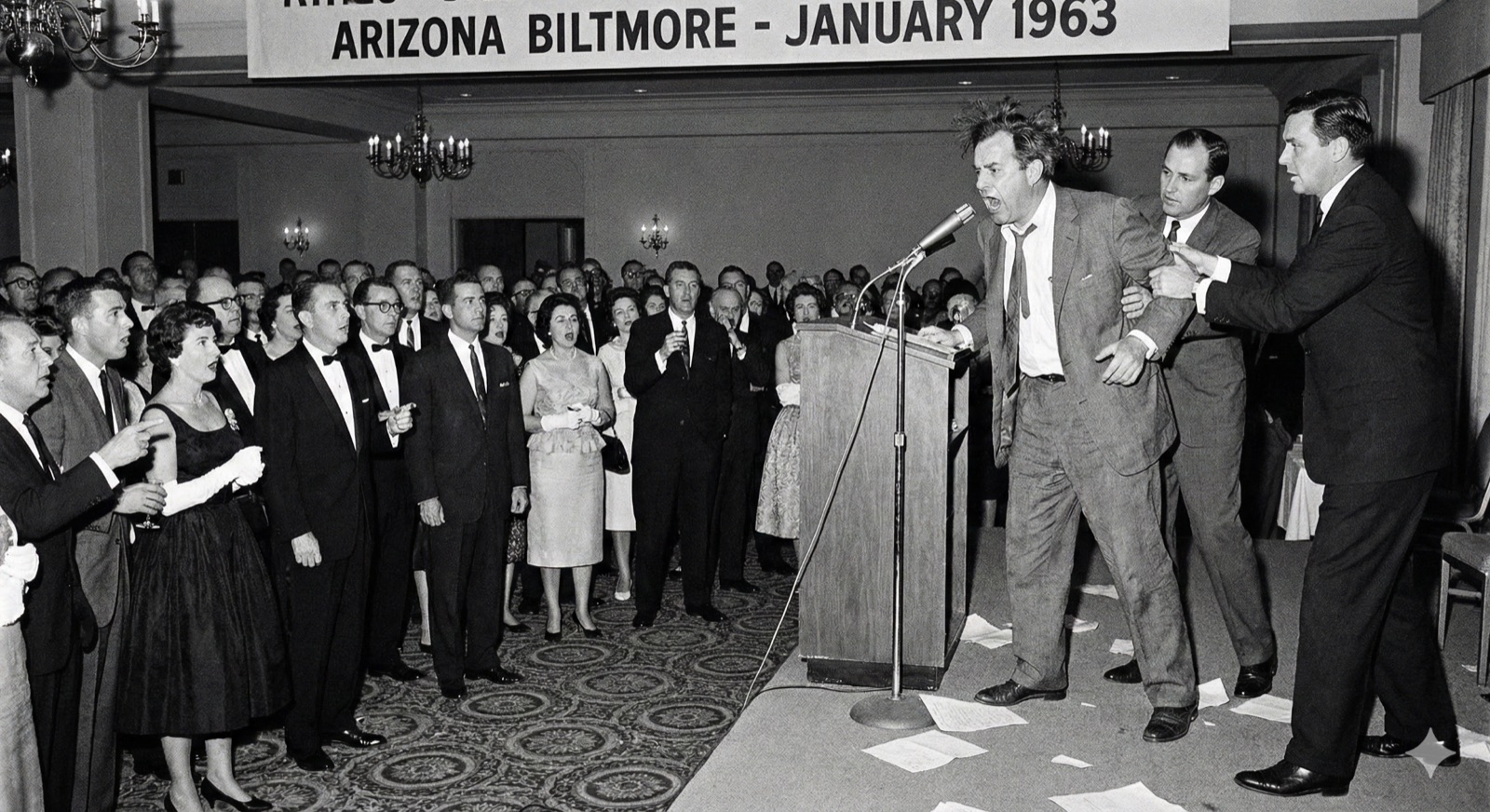
In January 1963, the crisis moved from the private drawing rooms of Georgetown to a public stage. Philip Graham traveled to Phoenix, Arizona, to attend a convention of the Associated Press and newspaper publishers at the Arizona Biltmore. He brought Robin Webb with him, flaunting the affair before his professional peers.1
The behavior Graham exhibited in Phoenix was described by witnesses as "inebriated and/or manic".12 He was a man possessed. He interrupted meetings, harangued fellow publishers like Otis Chandler of the Los Angeles Times, and engaged in erratic displays, including reportedly stripping off his clothes in a public area.7
3.2 The Speech: Shouting Secrets
The climax of the Phoenix trip—and perhaps the moment Philip Graham signed his own death warrant—was a speech he delivered to the gathered editors. It was not a prepared address on the state of journalism; it was a primal scream of secrets.
Drunk and manic, Graham took the microphone and launched into a tirade. He attacked the CIA, the organization he had helped embed in the American media, railing against its manipulation of journalists.2 Then, he dropped the ultimate bombshell: he publicly revealed that President John F. Kennedy was having an affair with Mary Pinchot Meyer.13
3.3 The Mary Pinchot Meyer Factor
The revelation of the Mary Meyer affair was radioactive. Mary Meyer was not a random socialite; she was the ex-wife of Cord Meyer, a high-ranking CIA official who headed the International Organizations Division—the very division responsible for the agency’s covert funding of student groups and cultural fronts.14 Mary Meyer was a complex figure. She was an artist, a pacifist, and a seeker who reportedly smoked marijuana and took LSD with the President. She challenged JFK’s Cold War hawkishness, urging him towards rapprochement with the Soviets and Cuba. In the eyes of the CIA hardliners—men like Counterintelligence Chief James Angleton—she was a security risk of the highest order. She was "changing" the President, making him soft on communism.15 By exposing this affair, Graham did three things:
● He threatened the moral legitimacy of the Presidency. ● He humiliated a top CIA official (Cord Meyer) and exposed the incestuous, adulterous nature of the Washington elite. ● He signaled that he could no longer be trusted with the state’s deepest secrets.
3.4 The Extraction
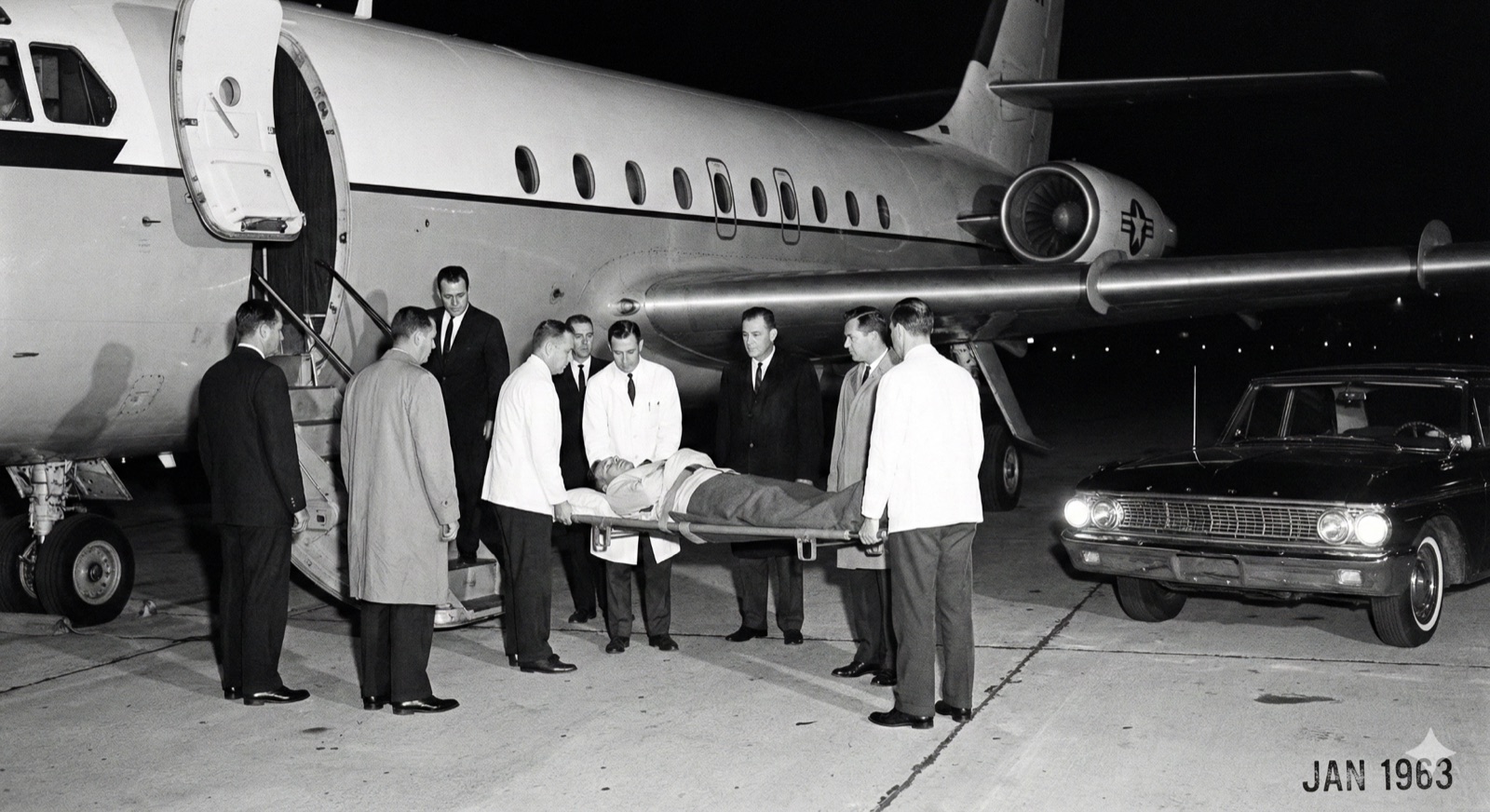
The establishment’s reaction was immediate and paramilitary in its precision. James Truitt, Graham’s assistant at Newsweek, alerted Dr. Leslie Farber, a psychiatrist associated with Chestnut Lodge.11 Otis Chandler and others physically removed Graham from the podium.
According to some accounts, a presidential jet was dispatched by the White House to retrieve Graham from Arizona—an extraordinary intervention that underscores the panic his behavior induced in the Oval Office.11 Graham was sedated, placed in a straitjacket, and flown back to Washington. He was immediately admitted to Chestnut Lodge, a private psychiatric hospital in Rockville, Maryland, known for treating the elite and for its ties to the intelligence community.5
The Phoenix incident was aggressively suppressed. No newspaper reported the content of Graham’s speech or his revelations about JFK and Mary Meyer. The "Mighty Wurlitzer" worked; the silence was total.
Part IV: Legal Warfare and Institutionalization (February – June
1963)
4.1 The Battle for the Will
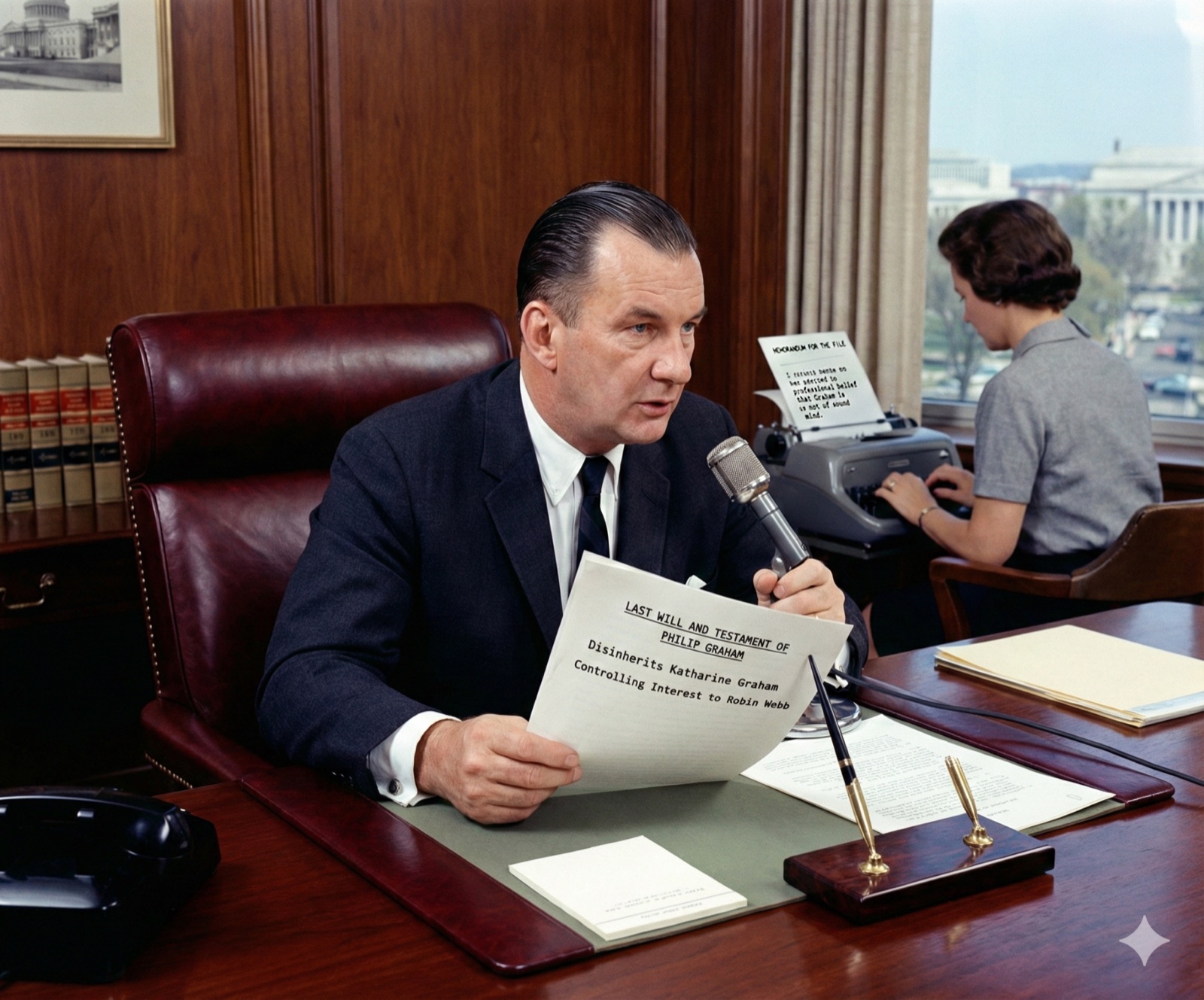
Following his institutionalization, a brutal legal battle ensued behind closed doors. Graham was formally diagnosed with manic depression and treated with psychotherapy and heavy sedation. However, during his periods of lucidity, he remained determined to divorce Katharine and disinherit her.
In the spring of 1963, Graham engaged Edward Bennett Williams, the legendary Washington attorney, to rewrite his will. Graham’s instructions were explicit: he wanted to leave his controlling interest in the Washington Post Company to Robin Webb.1 Williams, a consummate insider, found himself in a delicate position. He was Graham’s lawyer, but he was also a guardian of the establishment. He executed a strategy of duplicity. He drafted the new wills as Graham instructed—Graham rewrote the document three times in the spring of 1963, each time reducing Katharine’s share.2 However, Williams simultaneously wrote "memoranda for the file" documenting his belief that Graham was not of sound mind at the time of the drafting.1 These memos were a poison pill, designed to invalidate the very documents Williams was being paid to create.
4.2 The Divorce Threat and Property Division
Graham pushed aggressively for a divorce settlement. He demanded a division of assets that would give him the Post and Newsweek, leaving Katharine with the broadcast stations or other assets. He threatened to drag the family through a public scandal if they resisted. Katharine Graham’s lawyer, Clark Clifford—another titan of the defense and intelligence establishment—advised her to hold firm.2
The legal strategy of Katharine’s team was to delay. They operated on the assumption that Graham’s mania would eventually crash into depression, or that his legal standing could be challenged on competency grounds.
4.3 The Brief Release and Relapse
In June 1963, Graham was released from Chestnut Lodge. He briefly attempted to resume his life, but the depression that follows mania soon set in. He broke off the affair with Robin Webb, telling friends the relationship was over.12 He returned to Katharine, but the reconciliation was fraught. On June 20, 1963, he re-entered Chestnut Lodge for a second extended stay.12
Part V: The Death of Philip Graham (August 3, 1963)
5.1 The Request for Release
By late July 1963, Graham’s condition appeared to stabilize. He was charming, repentant, and ostensibly rational. He petitioned his doctors, Dr. Cameron and Dr. Farber, for a weekend pass, arguing that a change of scenery at Glen Welby, the couple’s farm in Marshall, Virginia, would aid his recovery. Despite some reservations, the doctors granted the request.11
5.2 Saturday, August 3, 1963
On the morning of Saturday, August 3—a date that marked the fifth anniversary of the Washington Post Company’s consolidation—Katharine Graham picked Philip up from Chestnut Lodge. They drove to Glen Welby.
The day began calmly. They had lunch on the porch, discussing the children and the future. Around 1:00 PM, Katharine went to her second-floor bedroom to take a nap. Philip reportedly said he would go to a different part of the house.11
Minutes later, a loud report echoed through the farmhouse. Katharine rushed downstairs. She found Philip in a first-floor bathroom. He had died from a massive gunshot wound to the head. The weapon was a .28-gauge shotgun.11
5.3 Forensic Ambiguities
The death was immediately ruled a suicide. No autopsy report was ever made public, and the police investigation was perfunctory.2 However, the physical mechanics of the death have fueled persistent speculation:
4. The Weapon: A.28-gauge shotgun is a long-barreled weapon. Using such a gun to inflict a self-inflicted head wound typically requires an awkward physical contortion (often using a toe to pull the trigger), yet the details of his body position were never clarified publicly.
5. The Scene: The bathroom setting suggests privacy, but the choice of a shotgun—a weapon of war and hunting—introduced a level of violence that seemed to match the ferocity of his manic episodes.
Part VI: The Aftermath (August – September 1963)
6.1 The Funeral of the Imperium
The funeral was held on August 6, 1963, at the Washington National Cathedral. It was a tableau of the American power structure. President Kennedy attended, sitting solemnly in the pews to honor the man who had exposed his affair with Mary Meyer only months before.18
The attendance list read like a roster of the "Georgetown Set" and the CIA leadership. The establishment closed ranks around Katharine Graham. Philip was eulogized as a visionary publisher; the chaos of his final year was smoothed over into a tragedy of illness.
6.2 The Probate Hearing (September 1963)
The final act of the drama played out in a probate court in September 1963. The future of the Washington Post hung in the balance.
The wills Graham had drafted leaving the company to Robin Webb were presented. However, Katharine’s legal team, armed with Edward Bennett Williams’ secret memoranda, challenged them. Williams took the stand and testified that his client, Philip Graham, had been of unsound mind when the wills were drafted.1 The judge accepted the testimony. He ruled that Philip Graham had died intestate (without a valid will). This ruling invalidated the bequest to Robin Webb and placed the estate in the hands of Katharine Graham and her children. A compromise was reached where Katharine gave up a portion of her personal inheritance to the children to secure absolute voting control of the company stock.1
6.3 The Transfer of Power
On September 20, 1963, Katharine Graham was elected president of the Washington Post Company.19 She was initially terrified, viewing herself as unqualified. However, guided by the "Georgetown Set" and advisors like Ben Bradlee, she assumed the mantle of leadership. The continuity of the Post as a pillar of the liberal establishment was secured. The threat of an outsider takeover was neutralized.
Part VII: The Intelligence Dimension and the Murder Hypothesis
7.1 The "Special Branch" Connection
The argument that Graham’s death was more than a suicide rests on his deep integration into the intelligence apparatus. His service in the Special Branch during WWII gave him access to the highest secrets of the war (ULTRA/MAGIC). He was not a civilian stumbling into secrets; he was a trained intelligence officer who understood the utility of information.1
7.2 Operation Mockingbird: The Founder Turned Liability Graham’s identification as the "founding director" of Operation Mockingbird implies he held the keys to the CIA’s domestic propaganda network.5 By 1963, his mania had made him a liability. He was reportedly talking about the CIA’s manipulation of the press, expressing "disturbance" at the very system he helped create.2
In the world of intelligence, an asset who becomes unstable and threatens exposure is a "burn notice" waiting to happen. Graham had already proven in Phoenix that he lacked the filter to protect state secrets. His threat to divorce Katharine and potentially open the Post to outside scrutiny (via Robin Webb) posed a structural threat to the CIA’s media assets. 7.3 The Mary Meyer Sequence
The timeline of deaths surrounding the Mary Meyer revelation is striking:
3. Jan 1963: Graham reveals JFK/Meyer affair.
4. Aug 1963: Graham dies (Suicide).
5. Nov 1963: JFK dies (Assassination).
6. Oct 1964: Mary Meyer dies (Murder).
Mary Meyer was murdered execution-style on a towpath in Georgetown. After her death, James Angleton, the CIA’s counterintelligence chief and a known associate of Graham, was caught breaking into her studio to search for her diary.20 The diary reportedly contained details of the affair and JFK’s turning away from the Cold War consensus. Graham was the first domino to fall in a sequence that silenced everyone connected to this specific node of intelligence and presidential secrets.
7.4 Institutional Suppression
The suppression of this history is itself evidence of its sensitivity. When Deborah Davis published Katharine The Great in 1979, detailing Graham’s Mockingbird role, Washington Post editor Benjamin Bradlee (a former intelligence officer himself) reportedly pressured the publisher to recall and shred 20,000 copies of the book.5 This aggressive censorship suggests that the narrative of Philip Graham’s life and death contains truths that the establishment deemed too dangerous for public consumption. ‘
Conclusions
The year from August 1962 to September 1963 saw the destruction of Philip Graham. Whether viewed as a medical tragedy of bipolar disorder or a darker narrative of intelligence containment, the outcome was the same: the removal of a volatile element from the center of American power.
Graham’s mania stripped away the polite veneer of the Georgetown Set, exposing the incestuous ties between the press, the presidency, and the CIA. His "Phoenix Incident" speech was a breach of protocol so severe it required a presidential jet and a straitjacket to contain.
His death by shotgun on August 3, 1963, resolved the crisis. It prevented the Washington Post from falling into "unsafe" hands. It silenced the man who was shouting about the CIA’s manipulation of the news. And it closed the file on the President’s most dangerous liaison. In the end, the system Philip Graham helped build—the Mighty Wurlitzer—played on without him, its secrets buried in the probate files of Edward
Bennett Williams and the silent grave in Oak Hill Cemetery.
Key Data & Timelines
Table 1: The Timeline of Collapse (Aug 1962 – Sept 1963)
Date                  Event                 Intelligence/Politica
                                            l Significance
Aug 1962 Graham’s affair with Destabilization of
                      Robin Webb            Post leadership
                      intensifies; manic    begins; security risk
                      episodes worsen.      increases.
Oct 1962 Cuban Missile Crisis. Graham acts as advisor to JFK/LBJ; access to high-level state secrets.
Dec 24, 1962          Katharine Graham      Graham declares
                      discovers affair via intent to divorce and
                      phone line.           seize corporate
                                            control.
Jan 1963              Phoenix Incident.     Critical Breach.
                      Graham exposes        Exposes
                      JFK/Mary Meyer        CIA-Presidential
                      affair.               link; sedated by Dr.
                                            Farber.
Spring 1963 Will Rewrites & Legal Edward Bennett
                      Maneuvering.          Williams drafts wills
                                            while documenting
                                            insanity.
June 1963             2nd                   Graham isolated;
                      Institutionalization breaks off affair;
                      at Chestnut Lodge.    diagnosed with manic
                                            depression.
Aug 3, 1963           Death of Philip       Suicide by shotgun at
                      Graham.               Glen Welby. Silences
                                            the "whistleblower."
Aug 6, 1963           Funeral at National   Attended by JFK and
                      Cathedral.            elite establishment;
                                            closing of ranks.
Sept 1963             Probate Hearing.      Wills invalidated;
Works cited
- Phil Graham - Wikipedia, accessed February 13, 2026, https://en.wikipedia.org/wiki/Phil_Graham
- Philip Graham - Spartacus Educational, accessed February 13, 2026, https://spartacus-educational.com/JFKgrahamP.htm
- Piercing the Fog: Intelligence and Army Air Forces Operations in World War II - GovInfo, accessed February 13, 2026, https://www.govinfo.gov/content/pkg/GOVPUB-D301-PURL-LPS47632/pdf/GOVPUB-D301-PURL-LPS47632.pdf
- Military Intelligence - Army.mil, accessed February 13, 2026, https://www.ikn.army.mil/apps/MIPBW/MIPB_Issues/MIPB%20Jul_Sep12%20smallest.pdf
- Why Philip Graham’s alleged Mockingbird role is rarely discussed.docx
- Katharine Graham - Wikipedia, accessed February 13, 2026, https://en.wikipedia.org/wiki/Katharine_Graham
- The Graham era ends at WashPost. Here's how it began. - Prof Chris Daly's Blog, accessed February 13, 2026, https://journalismprofessor.com/2014/09/03/the-graham-era-ends-at-washpost-heres-how-it-began/
- From Free Press to Fancy Dress - Spielberg's 'The Post' | Scoop News, accessed February 13, 2026, https://www.scoop.co.nz/stories/CU1801/S00109/from-free-press-to-fancy-dress-spielbergs-the-post.htm
- Philip Graham (1915-1963) - The George Washington University, accessed February 13, 2026, https://www2.gwu.edu/~erpapers/mep/displaydoc.cfm?docid=erpn-phigra
- Graham, Katharine (1917–2001) | Encyclopedia.com, accessed February 13, 2026, https://www.encyclopedia.com/women/encyclopedias-almanacs-transcripts-and-maps/graham-katharine-1917-2001
- Washington Post | Prof Chris Daly's Blog, accessed February 13, 2026, https://journalismprofessor.com/tag/washington-post/
- Philip Leslie Graham (1915–1963) - Ancestors Family Search, accessed February 13, 2026, https://ancestors.familysearch.org/en/K8BX-8MS/philip-leslie-graham-1915-1963
- Mary Pinchot Meyer - Spartacus Educational, accessed February 13, 2026, https://spartacus-educational.com/JFKmeyerM.htm
- Mary Pinchot Meyer - Wikipedia, accessed February 13, 2026, https://en.wikipedia.org/wiki/Mary_Pinchot_Meyer
- Plot to Kill the President: A Novel - Dominican Scholar, accessed February 13, 2026, https://scholar.dominican.edu/cgi/viewcontent.cgi?article=1181&context=books
- Masters of the Game - ABA Journal, accessed February 13, 2026, https://www.abajournal.com/magazine/article/masters_of_the_game/?utm_source=feedburner&utm_medium=feed&utm_campaign=ABA+Journal+Magazine+Stories
- How Accurate is The Post? The True Story of Katharine Graham vs the Movie - History vs. Hollywood, accessed February 13, 2026, https://www.historyvshollywood.com/reelfaces/the-post/
- File:President John F. Kennedy Attends Memorial Services for Publisher and Businessman, Philip Graham.jpg - Wikimedia Commons, accessed February 13, 2026, https://commons.wikimedia.org/wiki/File:President_John_F._Kennedy_Attends_Memorial_Services_for_Publisher_and_Businessman,_Philip_Graham.jpg
- Katharine Graham - Movie, Washington Post & Death - bio. (Biography), accessed February 13, 2026, https://www.biography.com/business-leaders/katharine-graham
- John F. Kennedy's lover kept a diary, and it was explosive - Mal Warwick on Books, accessed February 13, 2026, https://malwarwickonbooks.com/john-f-kennedys-lover/
- Mary's Mosaic: The CIA Conspiracy to Murder John F. Kennedy, Mary Pinchot Meyer, and Their Vision for World Peace - Google Books, accessed February 13, 2026, https://books.google.com/books/about/Mary_s_Mosaic.html?id=-Cv8DQAAQBAJ
- Benjamin C. Bradlee | Academy of Achievement, accessed February 13, 2026, https://achievement.org/achiever/benjamin-c-bradlee/