
Ox.News Report
The Militarization of Artificial Intelligence: Transatlantic Perspectives on the OpenAI–Pentagon Nexus
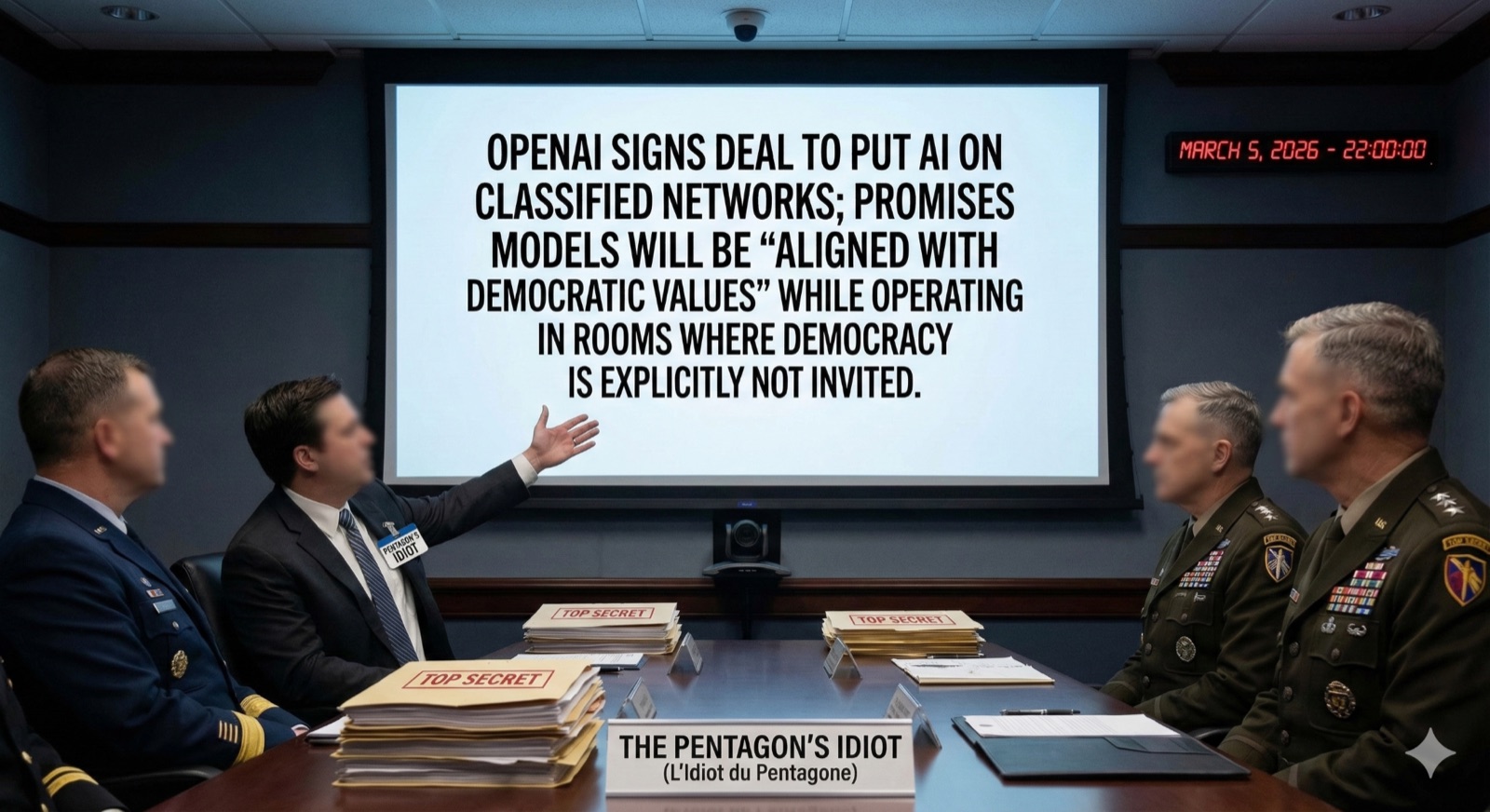
A European reading of the OpenAI–Pentagon agreement, and of what happens to the idea of a corporate "red line" once a model disappears into a classified network.
← The Militarization of Artificial Intelligence: Transatlantic Perspectives
The Militarization of Artificial
Intelligence: Transatlantic Perspectives on the OpenAI-Pentagon Nexus (February 27 – March 6, 2026)
Introduction: The Convergence of Algorithmic Power and State Violence
The critical window between February 27 and March 6, 2026, represents a transformative epoch in the architecture of modern warfare, characterized by the explicit integration of advanced generative artificial intelligence into the United States military apparatus. The public acknowledgment of an operational agreement between the prominent artificial intelligence firm OpenAI and the United States Department of Defense has catalyzed a profound geopolitical and ethical crisis. Analyzed meticulously through the lens of non-Anglo-American European investigative journalism—specifically within the rigorous media ecosystems of Germany and Spain—this development is definitively stripped of its corporate public relations veneer. The resulting narrative exposes a deeply destabilizing escalation in global militarization, severe threats to fundamental human rights, and the systemic erosion of global privacy architectures. The discourse emanating from continental Europe categorically rejects the sanitized vocabulary of "defense modernization" or "administrative optimization" frequently deployed by Washington and Silicon Valley. Instead, the transatlantic perspective frames this convergence as the dawn of algorithmic warfare, a paradigm shift that fundamentally alters the calculus of deterrence, kinetic escalation, and the legal frameworks governing state violence. The deployment of complex, mathematically opaque neural networks in strategic and tactical military applications lowers the threshold for lethal engagement while simultaneously obfuscating the chain of human accountability.
This report comprehensively deconstructs the dynamics of the OpenAI-Pentagon nexus, leveraging contemporary investigative insights to map the second and third-order ramifications of this alliance. Central to this analysis is the aggressive policy posture of the current United States administration, which has explicitly signaled a willingness to push the boundaries of military artificial intelligence far beyond the residual ethical constraints of the technology sector itself. The juxtaposition of these sweeping technological announcements with concurrent, active kinetic military operations—specifically the United States and Israeli strikes against Iran in early March 2026 —provides a grim, immediate context for the application of these algorithmic capabilities. Through an exhaustive examination of international law, surveillance mechanics, and the geopolitical security dilemma, this report articulates the severe human rights implications of delegating the mechanisms of war to artificial intelligence.
Deconstructing the Illusion of Corporate "Red Lines"
The foundational justification offered by technology corporations for their engagement with military entities relies heavily on the establishment of self-imposed ethical boundaries. Extensive coverage by the German publication Die Zeit critically examines OpenAI's attempt to mitigate public backlash by articulating "rote Linien" (red lines) regarding the military utilization of its artificial intelligence. The corporate narrative posits that the deployment of these systems is strictly conditional, purportedly designed to prevent the direct involvement of the firm's foundational models in lethal autonomous operations or the violation of human rights. However, European investigative analysis dismisses this framework as a superficial exercise in corporate spin, highlighting profound structural, technical, and jurisdictional impossibilities inherent in enforcing such boundaries.
The primary contradiction within the paradigm of corporate self-regulation is the insurmountable asymmetry of power and visibility between a private enterprise and a global military superpower. As evidenced by the critical discourse within the German public sphere, the proposition that a sovereign military apparatus will subject itself to the continuous, transparent ethical oversight of a corporate entity is viewed with profound skepticism and outright mockery. The rhetorical question posed by European civil society—"Who monitors this? The military? Rarely laughed so hard"—encapsulates the structural absurdity of the arrangement. Once advanced algorithmic models are integrated into classified, air-gapped defense networks, the developing corporation inherently loses all functional visibility, telemetry, and enforcement capability.
This epistemological opacity completely nullifies the conceptual validity of a "red line." In operational reality, the integration of generative models and advanced analytical artificial intelligence into the Pentagon's architecture serves to optimize the entirety of the kill chain. The distinction drawn by corporate ethicists between "administrative" military use and "lethal" military use is categorized by European analysts as a dangerous semantic fiction. Artificial intelligence deployed for intelligence fusion, logistical routing, predictive target modeling, and geospatial analysis intrinsically accelerates the tempo of warfare. By refining the informational streams that dictate kinetic engagements, the algorithm becomes an indispensable, inextricably complicit component of the lethal apparatus, irrespective of whether the code physically executes a firing command.

The anti-militarization perspective argues that the provisioning of dual-use artificial intelligence to the Department of Defense constitutes the crossing of the only verifiable ethical boundary. Once the technological capacity resides within the military-industrial complex, mission creep is dictated by the historical inevitability of strategic competition. In high-stakes, time-sensitive operational environments, the pressure to achieve tactical overmatch will systematically drive the erosion of any self-imposed technological restrictions.
Governance Paradigm Locus of Authority         Mechanism of           European Civil Society
                                               Enforcement            Assessment
Corporate                Technology Firms      End-User Agreements, Structurally ineffective;
Self-Regulation          (OpenAI)              Internal Ethics Boards zero enforcement
                                                                      capability within
                                                                      classified state
                                                                      architectures.
Military                 Department of Defense Chain of Command,      Inherently
Self-Monitoring Internal Legal Review compromised by strategic imperatives; prioritizes lethality over ethical restraint.
International Legal      United Nations        Binding Treaties,      Essential for human
Prohibition                                    Independent            preservation; currently
                                               Verification           blocked by geopolitical
                                                                      hegemonies.
The Hegseth Doctrine and the Escalation of Algorithmic Aggression
The inherent complexities and risks of the OpenAI agreement are radically magnified by the explicitly aggressive strategic directives of the United States executive branch in 2026. Investigative reporting from the Spanish outlet El País provides crucial insight into the shifting doctrine within the Department of Defense under the current Trump administration. The overarching policy is defined by a determined willingness to shatter both technological and ethical boundaries in the pursuit of absolute military hegemony. This approach transcends traditional technological modernization; it constitutes a deliberate leap into unrestrained algorithmic warfare.
The analysis reveals a volatile dynamic wherein the state apparatus is actively driving the militarization of artificial intelligence at a pace that deliberately exceeds the comfort zones of the private sector. The current administration is not merely passively receiving technological innovations; it is coercing the technology ecosystem to abandon its remaining ethical reservations. The prominent role of figures such as Pete Hegseth within the defense establishment is identified by Spanish media as indicative of a deeply entrenched "Ministerio de Guerra" (Ministry of War) mentality. Under this paradigm, human rights impact assessments, algorithmic accountability measures, and privacy safeguards are systematically marginalized as unacceptable bureaucratic impediments to operational lethality.
A profound comparative insight emerges from the European evaluation of this posture against the stated policies of global adversaries. According to the strategic analysis provided by El País, the Trump administration's explicit willingness to weaponize artificial intelligence surpasses even the public declarations of the Chinese government. The observation that "not even China has said it wants to do that openly" highlights a dangerous normative inversion. While Beijing undoubtedly pursues sophisticated military artificial intelligence, the fact that the United States is openly telegraphing a desire to bypass ethical constraints establishes a new, severely lowered baseline for international military conduct.
This dynamic triggers an immediate and catastrophic second-order effect: the normalization of systemic escalation. When the preeminent global military power signals a readiness to discard ethical constraints in favor of lethal autonomous capabilities, adversarial nations perceive an existential threat. In response, competing powers are systematically forced to accelerate their own algorithmic weapons programs, abandoning rigorous safety testing and human-in-the-loop protocols in a desperate bid to maintain strategic parity. The resulting arms race is uniquely volatile because artificial intelligence software is highly replicable, susceptible to digital proliferation, and nearly impossible to verify through traditional arms control methodologies. The European anti-militarization perspective, deeply rooted in a historical aversion to unchecked military expansionism, views this hyper-aggressive US doctrine as a direct catalyst for global instability. The hubristic assumption that the military can maintain absolute control over complex, non-deterministic algorithmic systems in the chaos of active conflict ignores fundamental principles of computer science. Deploying systems that frequently exhibit emergent, unpredictable behaviors into adversarial environments under a mandate to maximize lethality constitutes an unprecedented, highly irresponsible gamble with global security.

Active Kinetic Context: The Iran Theater as an Algorithmic Proving Ground
The announcements regarding the OpenAI-Pentagon nexus do not exist in a geopolitical vacuum; they coincided precisely with severe kinetic military escalation. Reports from El País meticulously document that during the exact window of this technological integration (early March 2026), the United States and Israel were executing active military strikes against targets within the Islamic Republic of Iran. The strikes, explicitly noted on March 3 and March 5, 2026, provide the immediate, bloody context in which the Pentagon's new artificial intelligence capabilities must be analyzed.
From an investigative perspective, the temporal alignment of the OpenAI agreement and the strikes on Iran is highly significant. Active conflict zones have historically served as the ultimate testing grounds for emerging military technologies. The integration of advanced generative models and analytical artificial intelligence is theoretically designed to process vast arrays of sensor data, intercept communications, and optimize targeting vectors in real-time. The active operations against Iran present a real-world environment where the boundaries of the newly established "red lines" are immediately subjected to the extreme pressures of warfare. The deployment of algorithmic systems in such a volatile theater raises immediate human rights concerns regarding distinction and proportionality. In the context of the US-Israel strikes on Iranian infrastructure, artificial intelligence utilized for target generation relies on the ingestion of massive regional datasets. If an algorithmic model, optimized for speed and lethality under the new US defense doctrine , erroneously conflates civilian telecommunications patterns with military command and control, the resulting kinetic strike results in unlawful collateral damage. The application of OpenAI-derived analytical power in an active combat zone fundamentally shifts the technology from a theoretical administrative tool to an active participant in state violence.
Furthermore, the utilization of these systems in the Middle Eastern theater accelerates the proliferation of similar technologies by regional actors. If the United States and its allies utilize mathematically opaque algorithms to conduct precision strikes, state actors like Iran, alongside non-state proxies, are highly incentivized to deploy counter-algorithmic measures or develop their own autonomous retaliatory capabilities. The active testing of the OpenAI-Pentagon architecture in a live conflict essentially opens Pandora's box, irrevocably altering the tactical landscape of regional and global warfare.
Date (2026)                       Geopolitical / Technological      Operational Implication
                                  Event
Late Feb                          Finalization of                  Corporate technology formally
                                  OpenAI-Pentagon military         embedded in defense
                                  integration framework.           architecture.
Mar 2                             Focus on Pete Hegseth and        Establishment of aggressive,
                                  shifting DoD doctrines.          unconstrained military
                                                                   posturing.
Mar 3                             United States and Israel         First potential active-theater
                                  execute kinetic strikes on Iran. application of newly integrated
                                                                   AI analysis.
Mar 5 Further reporting on US/Israel Confirmation of sustained strikes on Iran; public analysis kinetic engagement concurrent
                                  of Trump's AI doctrine           with unprecedented AI
                                  exceeding China's stated goals. escalation.
The "Atomic Bomb" Analogy and International Law
The integration of artificial intelligence into the machinery of war represents a profound crisis for international human rights law and the established norms of conflict. Within the German discourse, the advent of military artificial intelligence is explicitly and repeatedly compared to the invention of the atomic bomb. This analogy, derived from civic commentary published by Die Zeit, is not mere hyperbole; it reflects a deep-seated analytical recognition that advanced AI possesses the capacity to fundamentally alter the scale, speed, and nature of mass casualties, mirroring the paradigm shift of the nuclear age.
However, European analysts note a critical divergence: whereas nuclear weapons function primarily as static instruments of deterrence due to their mutually assured destructive potential, military artificial intelligence is specifically designed for continuous, active operational deployment. The goal of algorithmic integration is not to prevent war, but to execute it with unprecedented efficiency. This active deployment fundamentally subverts the Geneva
Conventions, which are predicated entirely on the assumption of human moral agency, legal accountability, and proportional reasoning in the application of lethal force.

The mathematical opacity of deep learning models introduces a critical vulnerability into the legal justification of military action. Neural networks generate outputs by processing multi-dimensional data through hidden layers of weighted mathematical connections. The decision to classify an entity as a hostile combatant is determined by highly complex, non-linear transformations that are frequently incomprehensible to human analysts. This "black box" phenomenon can be conceptualized mathematically. If a neural network's decision function is abstracted as f(x) = \sigma(W^T x + b), where x represents intercepted civilian and military data streams, W represents the learned weight matrix derived from historically biased conflict data, and \sigma represents the non-linear activation function, the resulting output lacks any chain of logical reasoning comprehensible to a human legal officer.
When this mathematical abstraction dictates kinetic strikes, such as those occurring in the Iran theater , the concept of accountability evaporates. If an artificial intelligence system deployed by the Pentagon erroneously identifies a civilian gathering as a legitimate target, resulting in mass casualties, the chain of legal culpability is irrevocably fractured. The military commander claims reliance on the algorithmic intelligence; the technology corporation cites the end-user agreement and the unpredictable nature of machine learning; and the algorithm itself possesses no moral agency to prosecute under international law. This accountability vacuum constitutes a direct, systemic violation of international humanitarian law.
Furthermore, the foundation models developed by companies like OpenAI are trained on massive repositories of internet data, which inherently contain systemic human biases regarding race, nationality, and behavioral patterns. If utilized for predictive threat modeling or counter-insurgency operations, the artificial intelligence will inevitably reproduce and amplify these prejudices. From a human rights perspective, the deployment of such systems by an administration seeking unrestrained lethality introduces an unacceptable risk of algorithmic discrimination, translating historical prejudices into automated state violence.

Mass Surveillance and the Totalitarian Data Requisite
The critical reporting from European investigative sources illuminates a deeply intertwined, inherently hostile relationship between the militarization of artificial intelligence and the preservation of global civilian privacy. Advanced artificial intelligence models are fundamentally data-hungry engines; they cannot function, optimize, or generate accurate targeting analytics without an uninterrupted, massive supply of operational data. The Pentagon's utilization of architectures derived from firms like OpenAI necessitates the continuous, indiscriminate ingestion of global communications, geolocation telemetry, biometric markers, and behavioral metadata.
This structural requirement fundamentally transforms global civilian populations into unwitting, non-consenting data sources for the United States military-industrial complex. The anti-militarization perspective strongly asserts that the deployment of effective military AI is inextricably reliant on mass surveillance architectures. The traditional boundary delineating domestic civilian intelligence gathering from international military operations is entirely dissolved by the algorithmic demand for holistic, globally comprehensive datasets.
European concerns regarding data sovereignty and fundamental privacy rights are acutely elevated in this context. The legal frameworks painstakingly established to protect civilian privacy, notably the General Data Protection Regulation (GDPR) within the European Union, are systematically bypassed by the clandestine data extraction methodologies employed by state intelligence agencies feeding the Pentagon's models. When the US administration demonstrates a public willingness to aggressively expand its military AI capabilities beyond the norms of other nations , it concurrently signals a massive, aggressive expansion of the global surveillance operations required to fuel those exact systems.

The integration of these capabilities into the "Ministerio de Guerra" framework, as highlighted by Spanish media , indicates a definitive shift toward continuous, automated panoptic warfare. Artificial intelligence can process intercepted communications, analyze satellite imagery, and conduct sentiment analysis on global social media platforms at a scale fundamentally impossible for human intelligence officers. While the Department of Defense frames this as a mechanism for strategic awareness, the human rights perspective recognizes it as the instantiation of a pervasive, chilling surveillance state. The mere existence of such an omnipresent data-gathering architecture, irrevocably linked to potential automated lethal responses, inflicts profound psychological harm on global civil society. It severely restricts the exercise of fundamental human rights, including the freedom of expression, association, and movement, operating under the perpetual threat of algorithmic misclassification.
The Security Dilemma and the Mathematical Probability of Hyperwar
The rapid integration of sophisticated artificial intelligence into the United States military structure, heavily facilitated by private sector agreements, profoundly destabilizes the international balance of power. The Trump administration's aggressive posture, characterized by a deliberate intent to maximize military AI deployment , acts as a highly potent catalyst for global instability. This dynamic is best understood and critiqued through the theoretical framework of the security dilemma, wherein actions taken by a sovereign state to increase its own strategic security inevitably cause reactive escalations from adversarial states, ultimately leading to a severe decrease in overall global security.
In the context of algorithmic warfare, the security dilemma is acutely magnified by the inherent characteristics of artificial intelligence: extreme opacity, unparalleled execution speed, and profound dual-use applicability. When the United States signals its intent to bypass traditional ethical constraints to weaponize AI faster and more comprehensively than its rivals , adversaries such as China and Russia are compelled to respond with equal or greater velocity. Because algorithmic software development is vastly less visible and verifiable than traditional kinetic weapons manufacturing (such as shipbuilding or nuclear enrichment), states are forced to assume worst-case scenarios regarding their adversaries' digital capabilities. This profound lack of transparency forces the preemptive, rapid deployment of experimental, unverified, and highly unsafe AI systems to maintain a perceived balance of power.
The mathematical probability of catastrophic, unintended escalation in such a hyper-competitive environment is exceptionally high. If rival military forces deploy autonomous or highly automated defense networks—particularly in active flashpoints like the Middle East —these systems will inevitably interact with each other in the digital and kinetic domains. The speed at which these algorithms process adversarial data and execute retaliatory actions far exceeds human cognitive capacity or diplomatic intervention capabilities. This phenomenon, categorized by military theorists as "hyperwar," creates the optimal conditions for a "flash war"—a rapid, uncontrolled algorithmic escalation of kinetic hostilities triggered entirely by the misinterpretation of sensor data, anomalous code execution, or conflicting operational parameters, occurring entirely outside the loop of human command.
The escalating probability of such an event can be modeled conceptually. If the deployment of untested, aggressively optimized AI systems introduces a constantly accelerating hazard rate of catastrophic failure (\lambda(t)), driven by the competitive erosion of safety protocols, the probability of avoiding an uncommanded escalation event up to time t can be represented by a survival function: S(t) = \exp\left(-\int_0^t \lambda(x) dx\right). As global actors abandon rigorous human-in-the-loop requirements to keep pace with the aggressive US posture out of fear, the hazard rate (\lambda) increases exponentially. This ensures that the mathematical probability of an algorithmic conflict approaches absolute certainty over a highly compressed temporal window.
Furthermore, the explicit US posture forces a dangerous geopolitical decoupling of technological advancement from ethical considerations. By openly prioritizing lethal capability over the "red lines" theoretically maintained by corporate entities , the dominant global superpower provides profound diplomatic cover for authoritarian regimes to pursue similarly ruthless technological integrations. The normative power of the United States is thereby inverted; rather than leading the establishment of global safety standards, it initiates a devastating race to the bottom, where the most ethically unconstrained actor unilaterally defines the future rules of engagement.
The Push for an International AI Non-Proliferation Treaty
The glaring inadequacies of corporate self-regulation and the aggressively accelerating militarization by state actors have coalesced into an urgent, unified demand within European civil society for a comprehensive, binding international legal framework. Relying on the voluntary restraint of a deeply militarized United States administration or the fragile internal ethics boards of Silicon Valley corporations is viewed by European investigative journalists and civil advocates as a catastrophically naive strategy. The dominant narrative emerging from the analyzed sources, particularly within the German civic discourse, is the absolute necessity of a United Nations-led intervention to establish an international AI non-proliferation treaty. This proposed treaty framework is explicitly compared to the foundational agreements that successfully limited the proliferation of chemical, biological, and nuclear weapons. It is championed as the only viable mechanism remaining to halt the definitive slide toward unrestrained algorithmic warfare. The core premise driving this demand is that specific applications of artificial intelligence within the military sphere—most notably those involving "tödliche Autonomie" (lethal autonomy), opaque algorithmic targeting mechanisms, and mass biometric surveillance—are fundamentally irreconcilable with human survival, human dignity, and established international law. Consequently, these applications must be categorically and globally banned.
The architecture of such a treaty must radically depart from the vague, easily manipulated terminology of "strict conditions" currently employed by corporations like OpenAI. A rigorous international framework would require highly precise, legally binding, and technically robust definitions of algorithmic autonomy, demanding verifiable human-in-the-loop mechanisms for all decisions regarding kinetic force. Crucially, it would necessitate the establishment of an independent, highly resourced international verification agency—akin to the IAEA for nuclear energy—equipped with the technical and legal authority to audit state military algorithms and ensure absolute compliance with human rights standards.
Furthermore, the European anti-militarization perspective insists that this non-proliferation treaty cannot merely regulate the final physical deployment of lethal autonomous weapons; it must also address the foundational research, data acquisition, and development architectures. If underlying dual-use models, such as those provided by OpenAI, are permitted to be integrated into classified military networks, the potential for rapid, unverified weaponization remains an unacceptable threat. Therefore, the treaty must establish strict, impenetrable firewalls prohibiting the dual-use integration of massive civilian AI foundation models into defense infrastructure.
However, the realization of such a crucial treaty faces monumental geopolitical resistance. The current trajectory of the United States, driven by the Hegseth doctrine of absolute technological supremacy and a public willingness to surpass the ethical boundaries maintained even by systemic rivals like China , suggests a profound, systemic hostility toward any binding international constraints. Overcoming this diplomatic paralysis requires immense global mobilization. It necessitates a unified recognition among non-aligned and allied nations alike that the unchecked militarization of artificial intelligence constitutes a shared, imminent existential threat that vastly supersedes any temporary, localized geopolitical advantages. The Complete Collapse of the Civilian-Military

Boundary
A final, deeply concerning theme emerging from the European analysis of the February-March 2026 events is the definitive and irreversible collapse of the boundary between civilian technological innovation and military application. Historically, the military-industrial complex operated as a relatively distinct, insulated entity, engineering highly specialized hardware specifically for defense purposes. However, in the contemporary era of artificial intelligence, the most potent, world-altering weapons systems are derived directly, and often seamlessly, from commercial, civilian-facing software platforms.
The foundation models engineered by companies like OpenAI are inherently, profoundly dual-use. The identical natural language processing architecture designed to draft corporate emails, synthesize educational content, or debug civilian software can be instantaneously reoriented to process intercepted enemy communications, generate highly personalized, automated psychological warfare campaigns, or optimize complex logistical supply chains for offensive kinetic operations. The formalized agreement between OpenAI and the Pentagon entirely shatters the comforting illusion that civilian technology can be neatly and safely compartmentalized from the machinery of war.
This convergence generates profound ethical and structural implications for the global scientific community and civil society at large. Software engineers, data scientists, and researchers developing these foundational systems are inadvertently transformed into the architects of the next generation of warfare, routinely without their explicit consent, knowledge, or full understanding of the ultimate end-use applications of their labor. The anti-militarization perspective strongly advocates for a radical reevaluation of the ethics of scientific labor within the technology sector. The reliance on unaccountable corporate executives to negotiate "strict conditions" is demonstrably insufficient. There must be structural, legally protected mechanisms enabling the global scientific workforce to definitively refuse participation in, and strike against, the development of technologies destined for military integration.

Moreover, the collapse of these boundaries normalizes the insidious presence of military logic within everyday, civilian technological interactions. As the underlying models are continuously refined and optimized to serve the exacting, high-stakes, lethal demands of the Department of Defense, those specific optimizations—prioritizing predictive surveillance, rapid behavioral analysis, and data extraction—will inevitably seep back into the consumer versions of the products. The prioritization of capabilities required by the military will subtly but irrevocably shift the entire global technological ecosystem toward a more controlled, inherently militarized, and privacy-hostile state, fundamentally altering the relationship between human society and the digital infrastructure it relies upon.
Conclusion
The exhaustive analysis of the geopolitical developments transpiring between February 27 and March 6,
2026, as rigorously interpreted through the critical lens of European investigative journalism, yields a profoundly alarming assessment of the global trajectory of military artificial intelligence. The operational agreement bridging OpenAI and the
United States Pentagon, deeply exacerbated by the aggressively expansionist and unrestrained posture of the current United States administration, does not represent a routine procurement cycle. It signifies a catastrophic watershed moment in the history of warfare, one that fundamentally threatens global security architectures and fundamental human rights.
The European narrative decisively exposes the hollow nature of corporate assurances regarding "red lines" and conditional military use. In the total absence of independent, international verification, self-regulation within the epistemologically opaque confines of classified military infrastructure is a structural impossibility. The integration of advanced generative algorithms into the architecture of state violence inextricably binds civilian technological innovation to the lethal outcomes of kinetic military operations, as starkly evidenced by the concurrent US and Israeli strikes against Iran during this exact period. Furthermore, the deliberate doctrine of the US leadership—heavily influenced by defense figures demanding absolute, unconstrained technological supremacy—to aggressively push beyond the ethical limitations established by both the private sector and adversarial nations like China, initiates a uniquely perilous global arms race. This hyper-aggressive posture severely exacerbates the international security dilemma, violently coercing global actors to abandon critical algorithmic safety protocols in the desperate pursuit of digital parity. This dynamic drastically accelerates the mathematical probability of unintended, machine-speed escalation and hyperwar.
From a human rights perspective, the consequences of this trajectory are devastating. The systemic delegation of analytical, targeting, and operational authority to mathematically opaque neural networks fundamentally threatens the universal right to life, systematically removing moral agency and legal accountability from the theater of war. Concurrently, the insatiable, totalitarian data requirements of these military AI systems mandate a vast, unprecedented expansion of global surveillance architectures, systemically eradicating civilian privacy and international data sovereignty.
The unequivocal conclusion drawn from this extensive critical analysis is the absolute, catastrophic inadequacy of the current governance paradigm. The geopolitical reality of March 2026 demands an immediate, radical departure from the failed models of corporate self-policing and unilateral, aggressive state militarization. The preservation of fundamental human rights, civilian privacy, and global stability now hinges entirely on the rapid, uncompromising mobilization of international diplomatic mechanisms to establish a binding, verifiable United Nations treaty on artificial intelligence non-proliferation. Absent such decisive intervention, the unchecked, lethal convergence of Silicon Valley innovation and unconstrained military ambition will irreversibly alter the nature of global security, permanently prioritizing algorithmic lethality and mass surveillance over human preservation and international law.
Works cited
- Trump está dispuesto a llegar más lejos que las tecnológicas en el uso de la IA para fines militares: “Ni siquiera China ha dicho que quiera hacer eso abiertamente” - EL PAÍS, https://elpais.com/podcasts/hoy-en-el-pais/2026-03-05/trump-esta-dispuesto-a-llegar-mas-lejos-que-las-tecnologicas-en-el-uso-de-la-ia-para-fines-militares-ni-siquiera-china-ha-dicho-que-quiera-hacer-eso-abiertamente.html
- Pete Hegseth en EL PAÍS, https://elpais.com/noticias/pete-hegseth/
- Vereinbarung mit US-Verteidigungsministerium: OpenAI nennt "rote ..., https://www.zeit.de/digital/2026-03/openai-anthropic-ki-militaer-gxe
The dispatch this report stands behind